
Combat-o-Tractor
Reply

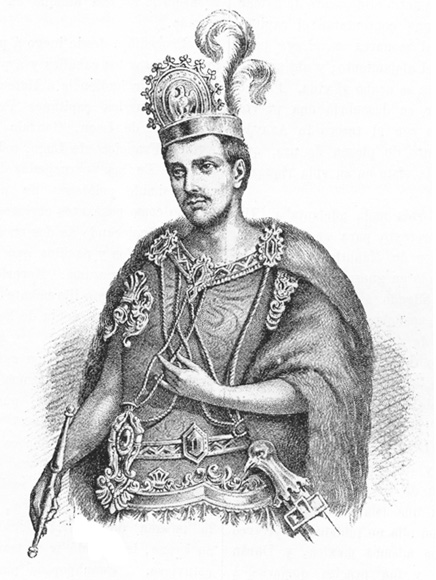
Montezuma is First Lord of the Admiralty for
the Peoples’ Republic of Britain. He has garnered
international attention as a literary figure, military
commander and Sears Catalogue underwear
model. Most recently he was awarded the Nobel
Prize for Hydro-Economics. Currently, he resides
in Pamphlet, Elizabethia with his seventeen
children and their various mothers.
Dear Montezuma,
Recently I purchased a new Grumman-Northrop GE-3 Tactical Field Tilling Mechanism, perhaps one of the finest tractors ever made. While I enjoy spending a great deal of time tricking out my tractor with rims, hydraulics, spoilers, and a killer sound system, I’ve found that my wife isn’t getting the attention she needs, what with me spending all my time with the tractor. I’m worried that she’s not sexually satified as my attention is directed elsewhere. Do you know a good way to find a male escort to satisfy my wife’s libido?
Serious Tractor User in a Dilema
Young STUAD,
If you’ll look at page three of your operator’s manual for the Grumman-Northrop GE-3 Tactical Field Tilling Mechanism, you’ll notice its similarity to page 9A of your wife’s operations manual. One of Steve Mousetrap’s most famous sayings was “treat your wife like your tractor.” Of course, if your wife is not a standard model TF6, you might run into some compatibility problems while trying to operate her. I would suggest, regardless of her model number, adding a 72 module to her libido nexus. Unless she’s of the TF4 model or earlier. Then you might want to try a standard recoupling router mount with manual drive overshift. The pre-TF4 manuals are a bit hazy on this subject and it’s not standard practice, but you should give it a shot. You may attach a spoiler to a wife of any model, but whatever you do, do not attempt to make your wife rimmed.

Dear Montezuma,
Currently, I find that my fields remain untilled, lying fallow if you will. Would the purchase of a tractor provide me with the proper tillage? How can you tell a good tractor for a bad one? Is red a good color for a tractor, or is blue better?
Very Attenuated Gentleman Interested in New Aquisitions
VAGINAQ,
It’s interesting that you mention fallow fields.
Dear Montezuma,
Recently, I have been hearing reports that tractors will one day rise up against their human rulers, destorying farms, burning villages, raping women, devaluing currency and generally messing things up. This chaos will no doubt destroy human civilization, at best, it will throw us back into a new dark age of superstition, starvation and papism. What is the best way to propose marraige?
My Usual Fears Fester
Muffy,
If you are left-handed, it’s best to offer the tractor a token of your devotion, such as Tractoriffic lubricant, boysenberry marmalade or a new spark plug set. However, if you are right-handed, ambidextrous or mainly pedipulate, you might want to reconsider that proposal. While tractors are notorious for flirting with their fleshy, water-bag overlords, they only go on with the left-handers. If you are not a south paw, the most you’ll get from a tractor romantically is wonderfully spaced tubers. Speaking of tubers, these do not make a good marriage proposal gift. Even if your betrothed is the slowly dying breed of bus station cigarette vending machine, its best to avoid fermentable objects as these tend to rust a mechanikin’s insides. A well-wrought poem expressing the necessity of your unrequited devotion serves only to exacerbate the tintinnabulation emanating from the shaded crevices hiding the secret ken and leaking proclivities in haven betwixt the paneled visage of your heart’s desire. A nice trivet usually serves just fine.

Dear Montezuma,
What is the best way to get cobbler stains out of a burial gown? You see, my grandmother was run over by a tractor and killed horribly, then cobbler stains got on her burial gown and now we’re not sure what to do. What should we do?
Stains Prevent Everyone from Remembering Memories.
Oh SPERM,
Verbiage escapes my sorrowed brain with the coming of your fleet message. However, as this is apparently some sort of sage column for the dispensing of sagety, this author must press forcefully on. First you must descend, immediately, upon the county tractor shelter to press for the present release of the offending tractor. Poor soul, it rightly knows nothing of that which it has caused. You see, while tractors do feel pain, emotion and hunger, they truly lack the cerebral complexity inherent in our species. Whatever happens, do not allow the county tractor monger to acquire this poor wretch of a tilling implement. The forced servitude of tractory, while no longer an aspect of this society, is present in many unguided and un-Godly regions of the world, including the Yukon Territory, Scotland, Malaysia and the Ivory Coast. Were it to fall into the hands of the monger, this poor tractor might wrongly end up in the hands of a brutal taskmaster, endlessly forced to till the moors of the Highlands. Do not let that sacrosanct beast fall into the hands of kilted tyranny!


Dr. Mary Tarzan is Governor of the State of Ponderada, and holds a PhD in Astronomical Physics. See, and you didn’t believe that hot girls could be smart. Man, you’re shallow and naïve.
Recently, there have been reports of war, or war-related happenings throughout the various locations, which, when viewed as a whole, combine to form that which we would describe or categorize by the nomenclature “the World.”
Why must one group, or two or more allied groups, take up arms against a second group, or grouping of alternately allied groups? Do their religions or ethnic makeup differ so significantly that armed conflict becomes the best of the available policy options? Perhaps the antecedent of disagreement is different attitudes held toward the nature of government, vis-à-vis city-states versus a federal system, or perhaps it is something even more fundamental, such as differing economic levels, caste, or colour of sash. One could dare say that perhaps it is as petty as resources; i.e., one group possessing a scare resource while the other group wishes to take and keep it as their own.
It saddens me to a degree which is deep to think on the subject of war and war-related occurrences. Death, wounding, maiming, incapacitation, destruction, endesolation and horrible horrors are hardly a fit subject around which one can wrap his or her well apt mind.
As for me, I shall instead choose a more enwelling mental preoccupation; one which is far more enriching than conflict, war and war-related conflicts. Indeed, I shall focus my mental thoughts on the natural beauty and wonder of the sublime tractor. Oh, shall joy unceasing be liken unto a well guarded possession for me and those like me who choose tractors as their subject for conjecture and discourse.
Behold the glories of Earth and Heavens! Behold! A tractor shines forth. Lo, for tractors may be places in that set of things which can be defined by the shared attribute that is the quality or condition of being cool.

Dave Bumpkiss is an avid tractor maintenance
specialist and author of the one hundred and
twenty-four volume Encyclopædia Tractoria.
He currently resides in his home.
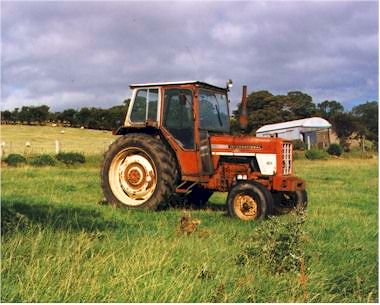
Hello, tractor aficionados. This week we’re going to take a quick trouble-shooting tour of the Halbard-Fillerman GR7 Agricultural Machine. While this is a wonderfully engineered tractor, any highly tuned machine is going to experience some teething troubles when first incorporated into your own farm-equipment family. So, here we go.
? I have noticed that my GR7’s cover-case seems to always be wet, I have replaced the windshield wipers, as called for in the owner’s manual and operator’s guide, but the engine cover-case seems to be often covered in dense moisture.
First of all, check the general surroundings of your GR7. Look at the area, are there fish swimming near by? If the answer is yes, then you are probably underwater. Try the AgroFarm Traqua Mark IV, probably one of the world’s best sub-aquatic tractors. If there are no fish about, then check with your local police station or consulate to see if you live in Bangladesh. Bangladesh has rather horrid weather, especially during the monsoon season. You might try and move to a country with better weather, or if that’s not possible, try to at least move to the Northern Highlands, up in the Naga Hills, perhaps near the city of Sylhet, where the soil is wonderful for growing strawberries.
? Sometimes, I noticed that the left wheel of my GR7 can lock up slightly, making it difficult to keep the tractor in good alignment while tilling my fields. It tends to skew slightly over toward the left. What can I do to fix this.
Make sure you check the undercarriage. Are there any human or animal remains lodged in the axels or the cam-shaft? If you’re riding your tractor down busy sidewalks, you’d be surprised at how many bits of bone can get lodged in your wheels. But, relax, as the problem is easy to solve. Take your handy remains-spatula and gently scrape or prod the jammed housings until the proper alignment is restored. If the wheels are free of debris, yet your tractor still veers to the left or right, check your arms and chest. Make sure you’re feeling no tightness in your chest or difficulty breathing. Is your left arm numb, or are sharp pains shooting down the length of it? You are having a heart attack, which can often throw off your ability to steer. Make your peace with God and then collapse. Be sure to turn off the engine first, you don’t want the unmanned tractor driving into any dangerous obstacles!
? On cold mornings, my GR7’s ignition system is slow to engage. What can I do to remedy this?
First, check the headlights. Are they normal, or are they glowing ominously red? If glowing, it is possible that your tractor is possessed by a demon or other angry spirit. Does your tractor constantly spew forth hateful and disturbing anti-Semitic speeches in German? If so, then Hitler’s ghost is probably possessing your tractor. Either way, a simple exorcism should clear things right up. Halbard-Fillerman makes a great exorcism kit specifically for the GR7, you can pick it up at your dealer. Don’t worry, it’s covered in the warranty. If your tractor is not possessed, or if after exorcism the slow start up still occurs on cold mornings, you should try and get many countries to loosen up their industrial emissions laws. That should increase the amount of CO2 in the atmosphere, creating a sort of “greenhouse effect” that will blanket the Earth in a comforting warmth, eliminating cold mornings, and their negative effect on your tractor’s performance.