The Society Page


A Description of the Happenings
All About the City of Bestoria

Attack Velocity 2: The Last Attack actress Jacinda
Sporkan returns from her wedding yesterday to Bestoria
Peregrine football quarterback Herb “The Wall” Halloran.
The couple will be taking their honeymoon in York, U.K.

Look who showed up at the Grand Opening of the new
Cannery on the Katharinetowne Industrial Parkway.
That’s right, it’s reclusive author Jamison B. Flindershdtadt,
who sources tell us is getting ready to write the
sequel to his bestseller A Hedgerow for Darius.

Local Bestboy Grip Dave Flan smiles for the
camera while partying at Triscoe’s Bodega.

April 23, 2004
Local Poet Search Turns Ugly.

H.G. Peterson, formerly of Esperia, says the process to choose the Bestoria Poet Laureate has been stymied by literati infighting. Peterson is best known for his amazing “Guide to Monkeys” published within this magazine.

And Peterson just might bail out the municipality’s search committee, which extended its deadline from January to April, when it failed to find any poets within the original two weeks specified who were willing and able to write verse about the General Worthington Expressway.

Though he prefers scarf and fedora to the more traditional laurels, Peterson contends, in various pentameters, that no one is suited more than he to Bestoria’s distinct rhyme and odometer.

“My poetry is synonymous with Bestoria and its people,” he told Axes & Alleys’ Romulus Augustulus. “Naturally, I’m be honored to assume the responsibilities of poetifying Bestoria.”

He’s written only one sonnet and few limericks, and is only published in obscure journals of various reputes, but Peterson is a true star. Earlier this century he helped bring poetry to impoverished Montsylvania. Few poets can point to a run of celebrity wives like he can.

Like other poets, Peterson often references the work of masters who came before him – and not just Thomas O’Reilley of Dublin. Keats wrote “Ode to a Grecian Urn.” Peterson wrote “Ode to the Fishing Trawler Which Brought My Fish.”

“I always wanted to be a monger of some sort,” he said. “It’s just now we call it a poet.”

Will the crusty committee consider Peterson’s work on par with that of Shinny Whitfield or Esther Yeardly?

“We’re not going to throw out his application,” said Arnold “Comfy” Silver, the 104-year-old Montsylvania College of Agricultural Technology Design Arts librarian managing the search.

To be eligible for the three-year honorary position, the poet’s work must contain at least 32 references to things Bestorian or be 26% Bestorian in nature, whichever comes last, and have lived in the general area for five years, and have at least one friend originating from Bestoria. They must also take a 500 question quiz on the historiography of the region and its people and show a fondness of carrots. Upon acceptance of the position they will be crowned with the official Poetic Nipple Rings; a much esteemed piercing.

Peterson says Bestoria was the inspiration for much of his poetry. His favorite, “Cleaning Coffins: The Saga of Brenford II with Persimmons,” refers to Bestoria specifically.

Though he recently left this the city for less poetic pastures in Aardvington, that does not disqualify Peterson from assuming the post, Silver said.

The committee, comprised mainly of area swineherds (who were originally the bastion of Bestoria’s poetic virtue), will review the applications in the coming days.

Several Poetical Stanzas from H.G. Peterson

“The Poe of Esperia”

H.G. Peterson is the Director of Children’s
Pop-Up Literature at the United States Library
of Congress. He is an internationally recognized
authority on 19th Century whaling vessels.

World War Two: A Poem

Well ol’ Mister Winston Churchill insists
We’ll never surrender despite the Blitz
The British Empire should never fear
Just offer up blood, sweat, toil and tears
The Nazi’s have armies and much air power
But this will be Our Finest Hour

Herr Hitler on the other hand
That angry vegetarian
Had Panzer armies attack East and West
Because he thought Aryans were the best
The Germans picked quite a few fights
And France surrendered in three fortnights

Hiro Hito and the Japanese
Were conquering islands with the greatest ease
They took Manchuria and the Philippines
And Indo-China and all those pacific scenes
Ruled that whole Ocean with a mighty fleet
And an army that knew not defeat

Then in a day that lives in infamy
The Arizona was sunk by the Japanese
Pearl Harbor the US vowed to remember
For the Axis powers they’d dismember
MacArthur and Nimitz moved toward Japan
While upon Germany bombing runs were ran

But the Russians were in a hell of a state
With Nazi’s at the Moscow gate
So Stalin sent millions of guys into the attack
to drive the fascist invaders back
At Stalingrad, on the Volga’s banks
And on the steppes with guns and tanks

Then on D-Day Normandy was liberated
When the British and US troops invaded
Though the Bulge was quite a threat
The Germans had had their match met
The Russians poured in from the East
And the American advance refused to cease

In ‘45 it all fell down
When the Allies marched into Berlin town
The Axis situation became quite dire
With Hitler in a ditch on fire
The Germans surrendered, every man
But we still had to defeat Japan

The Japanese weren’t doing to so hot
For all their transports with torpedoes were shot
They had no oil with which to fight
Their navy had an awful plight
Lots of planes shot down and carriers sunk
Too many ships now underwater junk

Even kamikazes wouldn’t stop their foes
Nor banzai attacks and their deadly blows
Though the Japanese did really try
To make the American armies die
Continual attacks with the B-29s
Destroyed much behind enemy lines

The US liberated the Philippines lands
And landed on the Okinawan sands
Then we island hopped to Iwo Jima
And dropped The Bomb on Hiroshima
Thus after our nuclear adventure
The Japanese could only surrender

We had a party when we got the news
And so we called it World War II

When Good Things Happen to Bad People

An Amalgam of Factisms-Of-Interest From Across this Storied Land

By International Correspondent Jamie Tadpole.

Accadia State Medical Test Labs – Incidences of smoking are less pronounced in teenage lesbian poseurs than in any other sub-culture in present day Accadia, contributing to further such mismoral behaviour, unnamed experts say in a new study.

Almost 2% of teenage lesbian poseurs aged 11-20 said they smoked irregularly or not at all compared with over 40% percent for rightly chaste heterosexual girls in the ongoing study of unspecified adolescents.

Norkirk, Platha – Platha’s most annoying man is at large again. Thomas “The Condo Pooper” MacGillicutty, 46, has been awarded $15,000 CND for his unprecedented vandalism streak. Having broken into over 600 condos and excreting solid waste in main areas therein, MacGillicutty, 46, is on the lam and the Norkikrk DA has decided to drop all charges, instead awarding MacGillicutty, 46, for his efforts.

Augusta, Maine – Wendy Swenson, late of Portland, returned home from her turn in the Castlerock State Correctional facility after serving 14 years for Murder II. Upon returning home, Ms. Swenson discovered that her expenses had been paid up for the next six months by the family of her victim, Charles “Gloria” Gyatso. Citing principles of Buddhist thought, the Gyatso family then doused each other with gasoline and self-immolated as a sign of forgiveness.

Hout Bay, Elizabethia – Getting to the “bottom” of restaurant dress codes has been taken to new lengths by a Hout Bay restaurant floor manager who, in his off time from harassing working waiters, took it upon himself to inspect patrons for dress code violations.

Newlands resident Marcy Train said the manager, Bob Toynbee approached her complaining of her visible g-string undergarments. Glad for the attention, Ms. Train promptly invited Mr. Toynbee home for 45 minutes of intense sexual romping, including oral sex. Mr. Toynbee, in a rare show of civility, stated that Ms. Train had “the best ass ever.”

A Special Scientistics Section

An In-Depth Exploration of That Which Provides Sustenance and Balance for the Savage Realm

The Food Chain

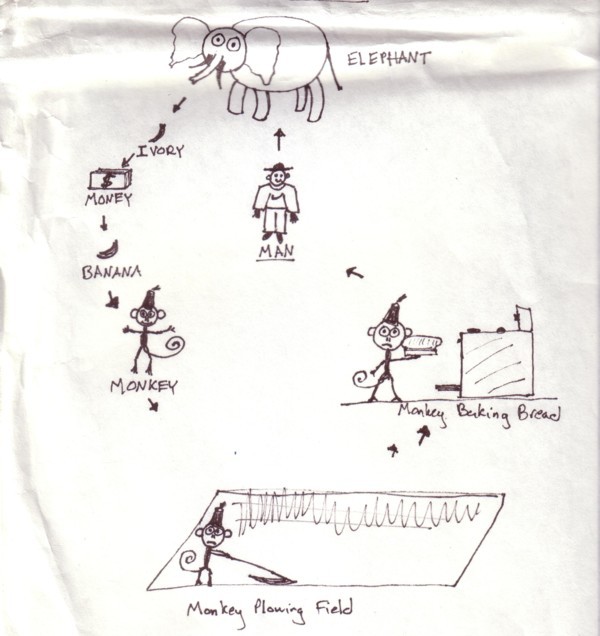
Food Chain

The MAN kills the ELEPHANT for his IVORY, which the MAN sells for MONEY.

With the MONEY, the MAN can by BANANAS to feed MONKEYS.

MONKEYS plow fields and grow WHEAT.

Other MONKEYS bake BREAD from the WHEAT.

That BREAD ends up on your table thanks to the food chain and cheap MONKEY labor.

An Histronomistics Report

A Special Study of Charlemagne
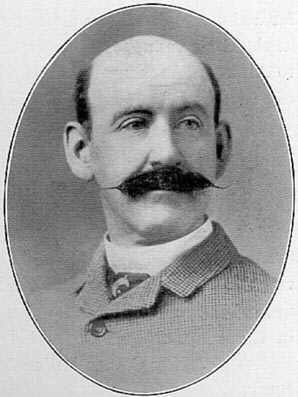
Dr. Scott G. Birdseye is Director of the Global Protection Foundation; a non-for profit group dedicated to ensuring successful proliferation of nuclear, biological and chemical weapons to needy Third World Nations.

Primary documents are of utmost importance to the study of history, for both establishment of fact and for understanding of the insight and views of those who lived in the past. While historical accounts do not necessarily record the complete truth, as they are biased by the perceptions and personal circumstances of their authors, these documents do fully illustrate how people viewed certain figures and events of later historical importance.

Three works which represent this construct of the aspects of primary documentation are Vita Caroli, De Carolo Magno, and Chanson de Roland, each of which shows a different view of Charlemagne relative to the authors’ own historical and social framework. Study of these documents can show how the image of Charlemagne changed greatly in the years following his death and how Charlemagne’s image evolved from that of a respected leader into that of a firmly established figure of myth and legend.

At the beginning of the twenty-first century, Charlemagne, as he is now known, is remembered as the
premier figure of Medieval Europe, the most influential and well-known ruler to rise from the anarchy and chaos of the post-Roman Imperial world. Born in 742, he became King of the Franks, and in 800 Emperor of the Holy Roman Empire, a post which he held until his death fourteen years later. Today, Charlemagne is seen, by some scholars, as the founder and defining force of what would become the modern European society, as, through his administration, brought together German, Roman and Christian cultures into one unique model, which would influence the image of both kings and government in Europe for centuries. This description of Charlemagne, however, is based upon earlier written works, works written during various times and for various reasons.

The first of these early works on Charlemagne was Vita Caroli, (The Life of Charles), which was written sometime between 829 and 836, by Einhard, a member of the court of Charlemagne at Aachen, and a personal friend of the magnate. Vita Caroli was written as an official history and was an attempt to record the life and deeds of the king. The close relationship of Einhard to Charlemagne would, as it seems, create an air of historical accuracy to the work, as Einhard was, in many cases, writing about incidents and events to which he was a personal witness.

However, this close proximity to the subject can also create inconsistencies, as Einhard was undoubtedly loyal to Charlemagne as both friend and subject. Thus, it becomes conceivable that Einhard’s writings held a favorable view of Charlemagne. However, despite the contiguity of Einhard and Charlemagne, Vita Caroli was written based upon earlier public records, to which Einhard, as an official, had ready access, thus negating some of the proximal validity held by the writing. Einhard also chose to neglect some aspects of Charlemagne’s life, particularly those which could be considered scandalous or lacking in propriety, in one case, the questions about the legitimacy of Charlemagne’s birth.

Einhard’s biography does illustrate how contemporaries of Charlemagne viewed the Emperor. While the writer does neglect the king’s improprieties, he mentions many details about the king’s private life, and tells about Charlemagne’s wives and concubines. The work does not overly glorify Charlemagne as a general, and speaks honestly about how limited his actual battle experience is. In all, the tale describes a normal man, who goes through simple daily tasks, dressing and eating, but a man who is also greatly respected for his advancements of learning and for his military campaigns. The fact that several groups of conspirators try to kill Charlemagne points to the idea that he may have been respected, but that this respect was not universal. Einhard, recorder of the documents, even doubts their place in history, and questions whether or not the stories of the life of Charlemagne would even be remembered in the future, despite his then current respect.

This respect had grown however, and by the time of Notkar the Stammering Monk of Gall, some seventy years after Charlemagne’s death. The writer, an elderly monk, living in the same monastery as the infamous Pepin the Hunchback, wrote De Carolo Magno as a trilogy describing Charlemagne’s piety, military prowess, and administration, although the final book was either never written or has been lost. The Stammering Monk never knew Charlemagne, and hence, all his knowledge of the man and his life, came from other sources. De Carolo Magno puts Charlemagne in the realm of the epic hero, and throughout the books, anecdotes and stories are told, the wholes of which form a mythical saga about Charlemagne, those around him, and the events of their lives.

There are important and obvious historical inaccuracies throughout De Carolo Magno, and these are borne out by the mythic nature of the saga and its heroes. The first book describes how bishops encountered the Devil and hobgoblins, and a story in the second book tells about Pepin and his encounter with the Devil. These supernatural occurrences lead to an interpretation of De Carolo Magno as a historically inaccurate document, written not to provide actual reference, but rather as a simple story book, illustrating moral lessons and using Charlemagne’s life as a vehicle for transmitting these moral lessons.

The idea that Charlemagne could be the subject of a collection of moral lessons about how to be courageous, loyal, observe holidays, and live a pious life, shows how Charlemagne’s image had changed only a few decades after his death. The Stammering Monk’s description of Charlemagne is not that of a completely human man who did many extraordinary deeds, but rather that of a noble hero, cultural icon, and nearly sanctified emperor whose gallant life is an example to all. With no powerful successor, Charlemagne had secured for himself an esteemed place, as with his empire in decline, the people, including the Stammerer, had no living cultural hero and thus looked back to the man who had provided astounding things for their world, but who was no more. Thus, did the enmythication of Charlemagne begin.

This ascendance of Charlemagne from respected king to cultural hero had become established as early as two hundred years after his death, as can be seen in Chanson de Roland, the epic tale of the defeat of the infidel expansions into Western Europe. The tale, written to describe the historical events in manner of epic quality, was written some time in the latter half of the twelfth century. While Charlemagne is not the central figure of the story, his place within the story provides important insight into twelfth century views of the first Holy Roman Emperor.

His role in the story is that of the benevolent king, commanding and overseeing the campaigns of Roland, the hero. As he sends Roland to battle, Charlemagne gives to Roland a sacred bow, a symbol of power, promises him almost divine protection, and speaks praising courage and heroism. Thus, Charlemagne is seen as the source and wielder of great power, and as a holy protector, who can promise supernatural safety, and as the personification of the virtues of courage. Therefore Charlemagne, while not the hero of the tale, is an important figure, one of mighty strength and majesty, and as a holy magnate, blessed by God and controlling his power on earth. Gone is the image of a well respected king, replaced by a nearly god-like figure who is the embodiment of all virtue.

While these three documents describing the life of Charlemagne do differ in many ways, and do contain information that is at times apocryphal, biased, and blatantly wrong, they each, in their own way, illustrate the ways in which the first Holy Roman Emperor was seen by people throughout three hundred years of history. As primary documents, the stories show how Charlemagne, a real figure and normal man who engineered important changes in European society, became known as a mythical hero of epic tales, and a near-saint of Herculean proportion, and why today, he is remembered as one of the greatest, if not the premier figure of Medieval European history.