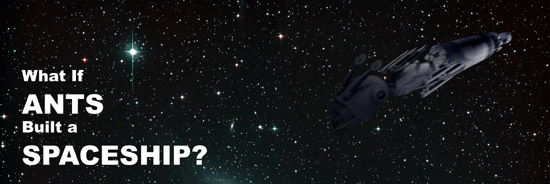
If ants built space ships most people assume they wouldn’t be very big because ants are quite small. Formic spaceships wouldn’t be as tiny as many assume, though, because ant colonies can get to be pretty large, covering acres of land to depths of several feet. Still, a spaceship built by a colony of ants wouldn’t be terribly huge.
The traditional image of ants created through science media is usually one of strife involving raids, slavery, and death. What if the space race brought the colonies together? I like to imagine that a space program would bring the entire race of ants together in a type of social insect utopia. In that case they would need a bigger ship.
A natural design for such a ship would be the shape of an ant itself, stylized of course to avoid infringing on the sensibilities of any species. From antennae to the end of the abdomen it would measure perhaps 12.7 kilometers long. The widest diameter of the ship would be across the abdomen, at around 6.1 kilometers.
The internal superstructure of the abdomen, legs, thorax, and head are to consist of enclosures which can be adjusted to the direction of thrust, providing a simulation of gravity. When the ship is in free-fall, the carpeted hallways will provide gripping points for the ants.
Propulsion comes through a hydrogen-fueled Bussard ramjet. The long, protruding antennae of the ship and the mandibles located at the front of the head are to produce the field for the craft’s ramjet. Interstellar hydrogen is to be guided through the mandibles and into the mouth, through the central fusion mass conduit modeled on an ant’s gut, and finally into the six fusion propulsion systems located at the tip of each of the leg structures. The fusion system will then provide thrust and power for the ship.
Biomass for the ants’ consumption would be located throughout the abdomen. Special fungus and aphid farms will be installed towards the front of this section for those species who require them. Otherwise the storage facilities will contain vegetable matter.
The thorax of the ship would contain gigantic environmental systems to handle the air and water needs of the ant colonies. The air processors will use oxygen and nitrogen generated by the biomass in the abdomen to supply the vast majority of atmosphere for the rest of the ship, while secondary storage and generation equipment remains on permanent stand-by in case of emergency. Since ants get most of their water from food, the water reclamation system required is much simpler as it is mostly there for the benefit of the biomass.
The filtration and recycling system is to be connected to the biomass storage facility through an open circulation system, constantly cycling water from the abdomen to the processing equipment and back. Connected to the fusion power plant at the rear of the abdomen through a set of tracheae, electrical distribution can be efficiently routed throughout the ship without sacrificing living or storage space. It can then be used as a secondary source for heating due to its proximity to the heating system.
The heating system will rely both on electricity coming from the fusion plant and the warmth from the moist, hot air created by the decomposition of vegetable matter in the fungus farms. After reaching the distribution junction, this air is then passed through the environmental system to extract its moisture, whence it passes to all points beyond.
Living space for the individual colonies will be located in the remaining areas of the abdomen. The fore section of the abdomen will feature environments dedicated mainly to those species residing in tropical and desert biomes, as these decks are closest to the heat distribution system. The top-most section will contain species from dry temperate locations, while the aft decks will contain species from wet temperate locations and those from cold or sub-arctic regions. Colonies residing near the engineering centers of the thorax will be those from environmental regions representing an extreme mix of temperatures and moistures.
The ship’s head is, naturally, to be the command and control centre. The lower portion will ensconce the main computer and auxiliary control systems (such as the Bussard field adjustment computer and environmental control). The upper portion, complete with multi-faceted view screens and other sensors built into the eyes, is the Bridge, which will be staffed by specially grown controller and navigator drones.
Astrogation and propulsion would be controlled directly from the Bridge. At the same time, command officer drones can issue orders to their various colonies through pheromone disseminating pneumatic tubes specific to each species. The pneumatic system carries a control pheromone to the appropriate colony located in the abdomen. From there a pheromone disbursement officer carries the message throughout the colony.
Colony Queens would spend the majority of their time at the Queen’s Deck, located in the bottom aft section of the abdomen, directly above the main docking bay. Most eggs will be kept in the temperature controlled storage decks, while some will be carried directly to the docking bay for placement on the landing pods used for colonizing suitable planets. The single airlock located in the extreme aft section allows for launching colonization pods, as well as for the jettisoning of trash and waste.
As you can see, a multi-species advanced interstellar craft for ants is a feasible idea for the most part. There are some problems surrounding ant cognition, manufacturing methods, and economic systems, but these can be overcome in time. Remember that Mankind took only six decades to advance from flight to space travel, and that ants have already been flying for millions of years.
After coming along with me on this beautiful journey into the possible, don’t you also think it would be wonderful for ants to reach for the stars, come together in filial admiration, and build a fancy, ant-shaped spaceship? I thought you would.