
If you enjoy Yeshua (aka Jesus), you might enjoy these other Christ-related Axes & Alleys articles:
Fifty Ideas for Making Insects Better

If you enjoy Yeshua (aka Jesus), you might enjoy these other Christ-related Axes & Alleys articles:
Fifty Ideas for Making Insects Better
By Lefgurt Jenkins

Mr. Jenkins affixes tax stamps to cigarette boxes for New York State. In his spare time he enjoys affixing tax stamps to cigarette boxes for the Commonwealth of Massachusetts.
I cannot stand it when I hear comparisons of car horns to rhinoceros horns. The differences are so obvious, it boggles my mind how I constantly have to hear how similar they are. It’s just such a stupid assertion. Really, it doesn’t even merit refutation, but I’d like to set the record straight once and for all.
Take a look at each horn. One is attached to a large, lumbering, cranky creature living in Africa and certain zoos. The other you cannot even see. It is stuck inside a car somewhere. You only know it is there because some ornery dandy lays on it. If you are still not convinced by their appearances, how about their construction? Heck, the rhinoceros horn is not even constructed. According to scientists, the rhinoceros horn is made of a substance related to hair.
The car horn is manufactured and installed in factories from Detroit to Japan. It is made of metal and electrical components. They are different because they serve different purposes; a car horn is supposed to make noise whereas the rhinoceros horn is used for fending off enemies or something. I am not really sure what it is for but it definitely does not make noise.
One of the most idiotic comparisons I have heard is that since people drive cars on Cape Horn, and Cape Horn looks something like a rhinoceros horn, they are similar. Hardly. Cape Horn is much thinner in appearance than the horn belonging to a rhinoceros. Furthermore, there is no logical way someone driving a car equipped with a horn on Cape Horn makes the car horn similar to a rhinoceros horn. It is just illogical, you know.
Do not even get me going on the fact that both Africa (where the rhinoceros lives) and South America (where the car horn lives) have capes. The only current connection either cape has is that they are bounded by the Atlantic Ocean, which certainly has a car horn relevance quotient of nil.
Sometimes you hear about footage from nature shows where a Range Rover honks its horn at a rhinoceros in the road as proof of some equivalence. This is not proof of rhinoceros horn-car horn similarity, in fact it proves the opposite because if you pay attention you will notice that when the car horn honks the rhinoceros horn never responds. Never.
Next time you hear a fool going on about how much alike the car’s horn and the rhinoceros’ horn are, remember the points I brought up above. You should not need them, though. Simply roll up a newspaper and smack the stupid dog across the nose and inform him that he is a “bad dog.” If your dog is like my dog, always going on about car horns and rhinoceros horns, I think that will help you keep your dog in check. Now, every time that dog starts up about horns, I grab a newspaper. He has learned his lesson; he slinks away with his tail between his legs and the debate is over. Over.
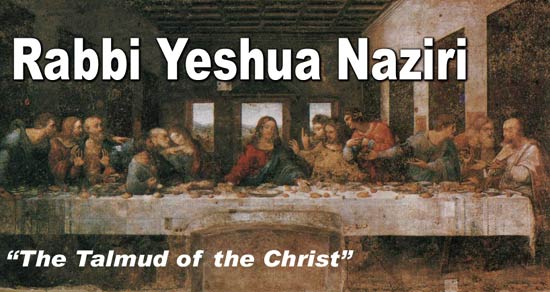
There is a tendency in the Christian world to view Yeshua Nazarite as the first New Age hippie; a long-haired, sandal-wearing likeable guy who strolled about Palestine spreading love and good feelings. While there is a grain of truth to this sentiment, Yeshua Nazarite was more than a friendly guy. Indeed he did spread love amongst the unlovable, peace amongst those foreign to it. However, he was also a scholar, a man learned in the Law and a religious Jew. Yeshua’s teachings did not appear via some process of parthenogenesis, but rather his ideas find their foundation in the Torah interpreted for use by ordinary people in a dangerous world.
The Rabbi as the spiritual leader in the Jewish community slowly evolved in response to the destruction of the Temple and the Diaspora. In the Middle Ages, Jews found themselves without a homeland, caught between Muslims and Christians, spread throughout the known world without a Temple or homeland to link them together. The Levite priesthood disintegrated, and Jewish thinkers such as Maimonides helped to popularize the Rabbinical method as a way to help unify and strengthen the Jewish community in a time of darkness.
Rabbinical thought has antecedents much earlier, but in a time when the priesthood dominated religious practice, the Rabbis were scribes and teachers, though rarely community leaders. While respected members of the community, their role was not truly divine. Unlike the Levites, their place was not set out in the Torah. In the time of the birth of the Roman Empire, Yeshua Nazarite was born into a Jewish community where scholars and priests co-existed, where the Rabbi’s role in the community was still evolving.
It is difficult to pin down the exact date of Yeshua’s birth, though reasonable to assume he lived from around 11 B.C. to 25 A.D. This was a time of great change in the Mediterranean world. A century of civil war had just ended and in the transition the Greek Kingdom in Egypt lost its independence, the Roman Republic was swept away and the world became ruled by the Roman Empire. Its Emperor, Caesar Augustus, became the God of the Known World. To the Romans, Alexander’s once mighty empire was nothing more than a pot of gold to be taxed and pillaged into oblivion. Not even the restored Temple in Jerusalem escaped the greedy Roman vultures.


During This Month in History…