
Axes & Alleys: As Glorious as the Pants of God.

When Socrates stated “Employ your time in improving yourself by other men’s writings, so that you shall gain easily what others have labored hard for” he probably wasn’t talking about Axes & Alleys: the world’s greatest tractor-related publication. It doesn’t matter. Just because the Classical Greeks never invented the tractor, doesn’t mean that you can’t spend your time improving yourself by reading the latest issue of everyone’s favorite magazine.
To download a PDF of the newest issue, just click here.
I hate the dentist. It always smells of straw and manure because of all the horses lined up to get shoed. The heat is oppressive, too, what with the furnace blasting away all day and the dentist’s apprentice stoking up the fires constantly.
Also, I’m not a big fan of the clanging and banging going on all the time. It’s already a painful process because the dentist is a teetotaler and won’t give me some of that whiskey anesthetic more accomplished dentists use.
And don’t get me started on the actual pulling. My dentist usually lets his apprentice do the dirty work and that kid never picks the right-sized tools. One time he could barely fit the thing in my mouth and tore my cheek a bit.
So I had to go to the surgeon’s, but he wasn’t there and his wife took care of me. I don’t like getting stitched up by the wife. Her place is full of bolts of wool and cotton, to which I’m allergic. Do you know how hard it is to get that big old needle through my flesh when I’m having a sneezing fit? It’s pretty hard. And painful!
So painful that sometimes it doesn’t go right and I have to wait for the surgeon to show up. Now, the problem with the surgeon is that he just doesn’t wash his hands when going from one project to another. No, he’ll be shaving one guy’s face, then cutting some other guy’s hair and finally gets to me. By that point I’m bleeding all over the place and he just sticks his lathered, stubble-flecked hands in there. At least he gets the job done quickly.
Of course, after all this I need to hit the pharmacist’s for a poultice of some sort. I really hate going to the pharmacist’s. It takes absolutely forever to get my prescription, sometimes two or three hours, and it smells awful there. This is usually because the pharmacist is always pouring various liquids on lead, or into boiling lead, or putting lead in bags and waving it at calico cats, or poking neighbourhood children with lead, or sometimes just up and throwing lead out the window. This is usually followed by a shout.
Eventually he gets around to giving me my poultice, which is occasionally pleasant (unless he uses some manure he picked up at the dentist’s in the concoction), although sometimes he gets interrupted by some idea having to do with lead again.
The poultice is warm and fragrant, though it doesn’t always seem to do much and my raw, oozing cheek stays that way for weeks and weeks. Sometimes it turns black and the smell starts bothering my wife. By this point another tooth is usually bothering me. I hate it when that happens, because then I have to go back and do the whole thing over again.
Man, I hate the dentist.
by Billy Bob Jordan

Over 520 million years ago a common ancestor gave rise to the chordates, creatures as varied as the shark, the trout, the frog, the gecko, the pigeon, the gopher, the sea squirt, and the lamprey. The first six animals represent a contemporary class of subphylum Vertebrata: Chondrichthyes (the cartilaginous fish), Osteichtyes (the bony fishes), Amphibia (amphibians), Reptilia (the reptiles), Aves (the birds), and Mammalia (the mammals). Along with Vertebrata, there are the Urochordata (animals such as sea squirts) and the Cephalochordata (the lancelets).
The Urochordata are truly strange. This subphylum consists almost entirely of the sea squirt, which got its name because it continuously pumps water into one body opening and out of another. Fossil evidence of the sea squirts is hard to come by because of their soft bodies. They look nothing like any other chordates, but in their larval stage exhibit all the characteristics of chordates: pharyngeal slits, dorsal nerve chord, notochord, and a post-anal tail.
Cephalochordata are not represented very well in the fossil record either, for they have few hard parts to their bodies. The lancelets, the prime example of the subphylum, are small, fishlike animals without real vertebrae, a primitive brain and poorly-developed senses. In some parts of the world they are of extreme importance for ocean farming.
Chordates first appeared towards the beginning of the Cambrian Era. Earlier, during a time known as the Precambrian Explosion, a multitude of phyla appeared, including the ancestors of the chordates. The earliest chordates probably resembled the lancelet in many respects and exhibited all of the characteristics of modern chordates.
Within the chordates soon appeared the jawless fishes, the earliest chordate form known to exist. These primitive animals are still represented today in lampreys and hagfishes. Soon, in geologic terms, the familiar amphibians were crawling about on land. Amphibians are ectothermic and generally spend much of their time on land, but are dependent upon large amounts of moisture found in an extremely wet environment such as a rainforest.
This dependence is due to three factors. The first, and most important, is that amphibians are not amniotes, that is they do not produce a protective membrane around their embryos. Secondly, amphibian young go through a metamorphosis wherein their forms are generally dependent upon the presence of copious amounts of water. Finally, most amphibians require the presence of a good amount of water to keep their skin hydrated and to respire.
From the amphibians came the reptiles, who were the first Chordates to walk away from the water. Reptiles are difficult to define and many biologists tend to define them by what they are not, rather than their relationships. Because they represent a class which gave rise to two other extant classes, this difficulty is understandable. Still, most reptiles are ectothermic, oviparous, scaled creatures.
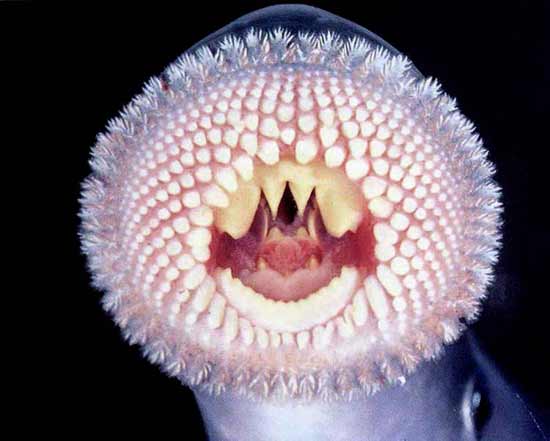
What a Mouthful: A lamprey. Of course, not all of the chordates are this friggin’ ugly.
Now, the reptiles bring up an interesting evolutionary development. From them arose the snake and the chameleon, but also other creatures familiar to the reader. From Reptilia arose to the therapsids, animals possessing traits of both reptiles and the later mammals which descended from them. As well, the bird descends from reptiles of the late Mesozoic Era, specifically during the late Jurassic period. Every time you see a sparrow, you’re actually looking at a relative of the dinosaur.
With the great extinction at the end of the Cretaceous period, the multitude of ecological niches which only the great reptiles were able to compete for were now opened to the birds and the weak, snuffling, mouse-like mammals. With this development, no further classes of chordate have arisen in the last 65 million years. If one were to make an estimate of when the evolution of a new class were to take place based upon the geological record, one might assume such a class appearing anywhere from 40 to 75 million years in the future.
While chordates do not represent the sheer number of individual species represented in the Arthropoda, their representatives range across the globe, from the most extreme to the most temperate environments and from the most familiar appearances to the strangest. Sea squirts, lions, echidnas, lampreys, vultures; all are our wonderful and strange cousins. Some, like the birds, arose as nearly as late as our own mammals. Some, like the jawless fishes are the oldest and alien to us. Some creep, some swim. Many might breathe air, while many others breathe water. Amongst us we share traits as diverse as skin or scales, eggs or live birth, feet or fins, even eyes or no eyes.
No matter our diverse biology, be it mongoose, shark, ball python, sparrow, or poison arrow frog we all share one trait: chordates are cool.
