Book
Reply

Dr. Scott Birdseye is the world’sforemost autodidact.
His manyworks include the notable tomes The Deities’ Chariots
and Deities from the Cosmos.
European society in the Middle Ages was dominated by a rigid structure which dictated nearly ever aspect of the people’s lives. This arrangement held the most power over the lives of the society’s lowest strata and thus, for the common laborers, life was defined by monotony and the endless struggle of physical existence. These aspects of peasant life on the manor are most evidently illustrated by the details of the commoners’ diet.
Peasants’ lives revolved around not only the ever continual production of food, but also around the necessity to meet the basic needs of survival. Thus, food was the central element in the lives of the peasants, acting as both their occupation and sustenance. Agricultural production was the singular purpose of the lives of the Medieval peasantry in Europe. The population of the Middle Ages was stratified into three major groupings: the nobility, the clergy and the laborers, although there were many other groups such as merchants and craftsmen whose roles did not fit with this concept.
Within the three major ranks of occupation, the nobility, whose place was to provide defense, and the clergy, who focussed on matters of religion and learning, were together only a small percentage of the population as a whole. The majority of the people were classified as Laboratores, commonly called peasants or serfs. It was the duty of the peasants to provide the actual labor which allowed the other divisions of society to exist. Thus, the life of the Medieval peasant consisted entirely of performing the tasks of farming; producing foodstuffs and other agricultural goods.
The Manor System provided for the organization of peasant labor output in Medieval Europe. The manor acted as a relatively self-contained agricultural unit, consisting of peasant homes clustered into small villages, plow lands, pastures, forests, water supplies such as rivers, streams and ponds, and the manor house, home of the manor lord, the noble land holder who ruled over the entire unit. While the primary purpose was to provide food, the manor also functioned as an economic entity to provide labor management and to produce a profit for the land holding lord. A system of mutual responsibility governed the manor; in exchange for labor the lord was expected to treat the peasants properly and not over work them. The lord was also expected not only to provide protection to the peasants as well as gifts on special occasions, but also to act as a mediator, judge and political and legal authority over his holdings.
Although the lord did provide protection and maintenance of social order, peasant life on the manor was fraught with difficulty and mired by monotony. In no way were these extremes more evident than in the peasant diet. Food on the manor was limited by what the land could provide, and for the most part, variety was unknown to the Medieval peasantry.

The diet of the commoners was essentially vegetarian and depended upon the staple crops of the particular geographical location. The most common crops were the cereals: wheat, oats, rye, and barley. Garden crops, which were cultivated on a much smaller scale, included vetches, beans, peas, onions, beets and lettuce, all of which provided some supplement to the daily menu. The most common vegetable products in Northern Europe were the cabbage and the turnip, while in the south olives and grapes were also privately grown. Despite these slight supplements, the peasants’ diet consisted mostly of grain, cooked into gruel, porridge, or coarse black bread made from rye, oats or barley.
Wheat bread was, for the most part, eaten only by the nobility. Daily fare for the commoners was often pottage, a dish which contained mostly barley or oats with some vegetables, which were slowly cooked in a large pot over the course of the entire day. Flavoring was sparse and rarely available to the peasants, although wild mustard seed, poppies and wild honey were occasionally used for seasoning, as was olive oil in Southern Europe. Pottage was usually eaten later in the day, so morning meals usually consisted of nothing more than bread and beer. The only available beverage for the Medieval peasantry was beer, which was brewed, without hops, in nearly every village. In Southern Europe wine of poorer quality was a common drink for peasants where beer was not available.
Dairy products such as cheese, eggs and butter were common in the Medieval world, although they were not always available for the peasants. Generally, sheep and goat products were the only diary foods available to the peasants, as bovine milk was reserved primarily for the nobles, although eggs were available to peasants in a limited manner. Meat was almost entirely unknown to most peasants, except at special occasions. Although many peasants raised chicken and sheep, eggs and wool were generally more valuable than meat, although older, less productive animals could be slaughtered for food.
Wild game unclaimed by the lord, which usually consisted of very small birds and fish, could also provide some meat for the laborers. As salt was both rare and expensive, peasants soaked what meat they had in lye to prevent spoilage. Despite this, meat was a rare thing in the average peasant’s life, seen only on the most important of holidays. In many ways, the calendar dictated the diet of the manor’s peasants. Although the calendar year defined the important agricultural tasks and labors, it also defined the significant holidays, feasts, and celebrations, occasions which provided the only available breaks from the tiresome monotony of the peasants’ lives.
The Lenten Breakfast, a feast which coincided with Easter was an important event in the peasants’ year. Following the penitence of Lent, the lord was expected to provide a sheep or a pig for the peasants’ observance of the feast. Martinmas was another important occasion on the manor, which peasants celebrated by slaughtering their oldest, weakest ox to provide meat for the long winter. Special events also provided peasants an opportunity to drink wine and eat wheat bread while performing the sacrament of communion. Peasants were often forbidden from taking communion more than once a year.
Manorial lords often tried to limit observance of holy days to no more than four a year, in order to keep peasants at work, but also because the lord was often expected to provide extra food for holy day feasts. Even with holiday feasts and gifts from the lord, food was always scarce for peasants, and starvation was terribly common especially during the long winter months. All year round, life for the peasants was difficult and tedious, and the few circumstances which provided any relief were fully appreciated.
In the fourteenth century, the epidemics and plagues which had ravished Europe reached their deadly crescendo, culminating in the waves of Black Death which swept across Europe erasing entire villages. A large portion of the population of Europe died from the outbreaks of plague in the mid-fourteenth century, including a great many peasants. Without readily available peasant labor, the manorial system began to decline, heralding the rise of the political and economic power of the cities. As the dominance of the manor disappeared, the agricultural system of Europe was forever altered, although the lives and diet of Europe’s common laborers changed little, although the later Middle Ages did see the rise and proliferation of taverns and other organized establishments which did cause some changes to diet.
Though diet may seem an unimportant aspect of the Medieval world, diet was in some ways an important avenue for social, cultural and political change. Spices, used to season food, were one of the main commodities traded with the East, and it was the search for new spice trading routes which provided one of the main incentives for the expansions of the later Age of Discovery. Though in later centuries, many changes in society impacted and changed diet, for the peasants of the Medieval manor, their diet was similar to their lives; bland, boring and monotonous.
by The Rev. Katie Phelps
Reverend Phelps is a renegade obstetrician and part-time
architect with buildings in Nunavut, Greenland and Yonkers.
She is an astute profiler of cabbages.
In this world of touch-screens, scroll wheels, buttons, sliders and switches, it’s often possible to think everything is perfect. “What could be missing,” I hear many people ask when examining their state-changing interface options. Some people are so happy with buttons that they do not realize the other common options available. So, what could possibly be missing from this world?
Knobs! I tell you, there was a day when knobs were king. There was a knob for the television, the radio, the gramophone. We had knobs for controlling the thermostat, knobs inside the refrigerator, knobs for our dogs and cats, even knobs in the car, of all places. Take a look around today. Do you see any knobs? No. All around are crude manifestations of state-changing interface systems. Most commonly, one finds buttons. You might think there’s nothing wrong with buttons.
You’d be wrong! Let’s examine the so-called “button.” A button does two things: move up and move down. You’ve got two options with a button, on or off. What good could possibly come from an on/off option? Here’s a button scenario. You go to your television and press the power button. The TV comes on, right? Well, yes, but what if you wanted it to come on at half power? You’re out of luck. That TV’s either on or off. You try making it do something different. You can’t. It’s just got a lowly button.
What about the touch screen? Oh, lookee, a touch screen. I can put my finger here and it does something. That’s not even at the level of a button. Barring not choosing anything, you get one choice: touch. You’re at the airport and you’re going to get your tickets from one of those kiosks with the touch screen. What if you want to order a sandwich? There’s absolutely no way to do it. You’ve just got whatever option is put up there to touch. You can’t even turn the damn thing off without resorting to a, you guessed it, button. That kiosk not only limits your choices to on or off, but also just to touching whatever they throw at you. Try getting a warm pair of socks from a ticket kiosk. I dare you.
Sometimes you might see a switch. It looks different from a button because it sticks out further and moves from one place to another. Wow, fancy. It moves. It’s also a mass-produced hallucination! While you think you’ve got a choice of several states with a switch, you’ve really just got a fancy button with a tail and that leaves you with an on/off choice. Walk into your living room and turn on the light. That’s it. There you go. Now turn it off. At least this time you had something to hold on to while you were getting screwed by the system. Now we get to the tricky part.
Look, my stereo has a set of sliders for the equalizer. Wonder of wonders, I can choose up to seven or more states for that there equalizer. Wake up, you ninny. Take a closer look at this tomfoolery. You know what that slider is? It’s another damn fancy button illusion. I move the bass from 1 to 2. Now I can move it from 2 to 3. See where this is going?
That’s right, a slider is just a dirty trick that moves what amounts to a bunch of buttons in sequence. Try getting that bass to 5.5. You’ll be there for a while. It’s just as much use as trying to get a falafel from an automatic ATM (don’t get me started on those). Trickiest of all is the modern scroll-wheel. You might think it’s like a knob and it works kind of like one, but try grabbing it. Some genius got rid of the wonderful grasping concept of knobs. If you’ve guessed that a scroll-wheel is just a bastardized and useless knob that should’ve been nailed by the heels to some Peloponnesian hill, then you’ve guessed correctly.
Obviously a knob you can’t hold on to is useless. Now you’re probably wondering what’s so great about knobs. Let’s try the previous examples and insert knobs into the situation. Watching TV one night, you realize that the TV is too bright. So you walk up to your television and there is a beautiful, shiny, sensuous knob. You’re eager to touch it and you do. You turn the screen down. It’s now kind of half on and half off. Amazing, no?
What if you were at the airport again? You walk up to the kiosk and instead of that putrid touch screen you have a beautiful pair of knobs just waiting for your patient hand. You dial an airplane ticket and a sandwich. You could even get a warm pair of socks after you’re done. You get home after your trip and walk from the darkened street into your home. You flip the switch, but the light is too bright! You fall to the floor in anguish, but immediately realize that you have a dimmer knob. You reach up and easily turn the light down to a more appropriate and eye-friendly level. Of course, if you were smart, you would have left the dimmer in a friendly position before you left home.
I want to listen to some music, but I want my bass at 5.5 and my treble at 5.1. What do I do? Simple, I’ve got a stereo with knobs and I turn it right there. Tiny Tim in perfect harmony. Who could listen to Tiny Tim with the bass at 5? A mongoloid sub-creature, that’s who. These previous examples completely obviate the need for a scroll-wheel. The scroll-wheel is poorly constructed to be a two dimensional knob. This is the future, man, 3D, virtual reality and whatnot. You don’t need state-changing equipment that requires special glasses! Now that it’s quite obvious that knobs are the superior engineering concept, what can you do to save them? That sound you hear is the sucking of a million knobs into the aether.
The giant industrial consortiums, the media and Congress have all in one way or another conspired to cut the knob from our tools. We must take back our knobs. When you see a forlorn appliance on the street, rescue its knobs. When you’re at the shopping center, pick only knobbed devices. Play with your knobs at all times. Help others to install your spare knobs wherever they might be needed: in the slot on a toaster, by the empty hole in their stereos and even replace old, worn-out knobs. Slip knobbery into casual conversation. Wear pro-knob clothing. Most importantly, don’t give a knob to strangers. You never know what they might do with it. That knob might end up damaged or lost.
Grab that knob and proclaim “this knob is mine!”
Bursting the Bubble of Complacency in Your Own Home-Town

Despite your own mental acumen, there will be times throughout your life when you lie prone under the icy, paralyzing grip of that creature we call Boredom. Therefore, as a public service we offer the following alleviations for your condition. Use them well and wisely and remember that Axes & Alleys, it’s creators, its parent and affiliate companies are not responsible for the consequences.
Escaped Mental Patient
Requirements:Two or more people, pajamas, pair of broken handcuffs, one or more lab coats, one or more butterfly type nets.
ActivityGot to a public place with one person dressed in the pajamas and handcuffs. This player is the mental patient. Others, dressed in lab coats will be the doctors. The mental patient runs around while the others try to catch him or her with the butterfly nets. Feel free to taunt each other loudly.
Pirate Attack
Requirements: Wheeled vehicle (car, shopping cart, red wagon), Jolly Rodger flag, pirate costumes and paraphernalia, two or more people.
ActivityPretty simple really, find a good spot, the Mall or Wal-Mart parking lot on a busy Saturday for instance, and ride around pretending to be 17th Century pirates. Say “Argh!” a lot. You can even have two ore more groups of pirates, all fighting over a “treasure” such as a gumball machine. Also, feel free to try and sell bootleg CDs and DVDs.
Visitors from Another World
Requirements: Grayish face paint, sunglasses or goggles, wigs and/or fake mustaches and beards, odd bulky or out of date clothing, and some suitably strange “alien” artifacts.
ActivityGet dressed up as aliens who have very poor human disguises. Choose one person to be the leader, who will speak, perhaps using an alien-earthspeak dictionary, while the rest of you stand in the back and exchange slight whispers of a strange alien language. Ask random people for directions, but don’t just ask about libraries or train stations…try and come up with unearthly things the aliens might want to find. “Where in this area would I find large quantities of hydrogen,” “Who the current human potentate and where might a fellow human locate them,” or “What do you know about frogs?”
Spies
Requirements:Two or more people, spy-like costumes (the more suspicious the better; trench-coats, dark glasses, a fez, an eye patch, you get the idea), spy paraphernalia; brief cases, newspapers with obvious eye-holes cut out, perhaps some microfilm.
ActivityPick a good public place, I personally think that the Main Concourse at Grand Central Terminal is the best. Come up with a couple teams of one or two people each. Perhaps the first team is trying to pass a briefcase around while the other team is trying to steal it away from them. There are many possibilities for double crosses. Make sure you reveal them as loudly and dramatically as possible. Remember, even toy guns could get you arrested, but spies can cleverly conceal a gun in a lipstick case, an umbrella or even their shoe. Outlandish accents can also add an international flair.
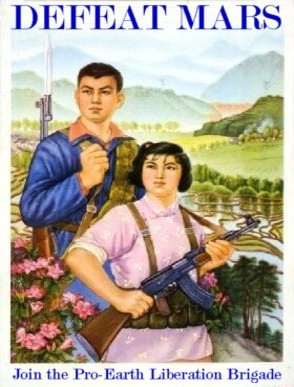
Earthling Liberation Front
Requirements: One or more people, some cardboard or poster board, clipboard, paper, pen, pamphlets or palm cards, paper cone or megaphone, and any strange military uniforms you can throw together.
ActivityPick a busy street corner. Set up your recruitment station; put up posters bearing slogans railing against Mars (Stop the Red Menace: Destroy Mars, The Only Good Martian is a Dead Martian, Earth First!). Get as creative as you can with your posters and tracts but remember you HATE the Martians. Give angry and hate filled speeches on the evil Martian Empire, the dangerous Flying Saucer Fleet, Martian plans for conquest. Whatever comes to you. Attempt to get passersby to join your Pro-Earth Militia. If people laugh at you, get indignant and respond with “You won’t be laughing when the flying saucers destroy this city!”
Museum Fun
Requirements: Bed sheets, sticks, primitive masks.
ActivityHead down to the local natural history museum and find any sort of large, old statue or idol. Set up in front of it and begin performing an elaborate dance or religious ceremony. Worship the statue, prostrate yourselves before it and be prepared to cite the First Amendment if museum personnel try to kick you out.
Bored Games
Requirements: Board game, two or more people.
ActivitySimply go to a public place, set up a board game, the more complicated the better, on the floor. Have fun playing untill the cops come to throw you out. Enjoy.
Exosouperous (Adj): That which has the quality or condition of not being soup, or that which falls into the set of all things in existence which are not soup.
Pentalupe (N): A grouping of wolves wherein the number of individual members is divisible by five.
Obsomnapillate (V: regular): To place a pillow over one’s head whilst sleeping.
Caliseptant (N): A person participating in the traditional American “7th Inning Stretch” during a game of baseball.
Revuluminter (V: regular): To screw in a light bulb.
Manipulatrouve(V: regular): To search frantically for a tool whilst in the midst of a repair project.
Ovofactorous (Adj): Something that smells of eggs.
Ubcasexsolartiensive (Adj): A person or creature which is waiting on a rooftop for a sunrise which will never come.
Disavioptic (N): One who is unable to extinguish between distant birds and enemy aircraft.
Malunibrew (Adj): A person, object or scene otherwise beautiful but for one bad feature.
Kerut (N): The last sound let out by a dying parrot.
Sumrapan(N): A trade-marked product name which has become so well known that the public begin to use it to describe all related products regardless of their trade-marked name, such as Styrofoam, Coke, Zipper, or Q-Tip.
Hellosh (N): A precipitation consisting of a stinging mixture of snow, rain and ice.
Animae (N): Animated film featuring a cast of anthropomorphic animals.
Catachristical (Adj): Any circumstance wherein a Jew and a Muslim give each other a Christmas related greeting or well-wishing.
Transalabaminate (V: regular): To pass through the State of Alabama by traveling from one bordering state to another.
Punctuarium (N): A chamber within a home used particularly for the storing of three-holed punches or reserved for the activity of using a three-holed punch.
Chenopodivite (N): One who subsists entirely on beets.
Autoparlimate (V: regular): To walk about in a public area engaging in a cellular phone conversation with another individual while wearing an earpiece, thus giving the appearance of talking to one’s self.
Biest (N): The act of leaving a party or other function for the purpose of retrieving more beer from a store.
Misericopull (N): A sexual act based more in the feeling of pity than in a genuine attraction.