Land: A Concise History of Civilization

A Concise History of Civilization

Historians spend years, sometimes decades, sifting through primary documents in their attempts to uncover the reasoning behind events in the past; both grand and trite. They’ll offer a host of explanations, descriptions, and analyses to explain why a war started, or how a people disappeared. They’re wasting their time. It all comes down to land. Just patches of dirt; patches of dirt with flora and fauna, and if you’re lucky, some iron ore.

To begin our exploration, let me tell you about the early history of a people, a well-documented history, which while it may be a little faulty in the details, still seems to get the larger view correct according to archaeological and historic study. Let’s talk about the Hebrews.

Their origin and actions are detailed in The Testament. Not the Old Testament. After all, they wrote the thing and so we’ll ignore those “New Testament” shenanigans. To them it was just The Testament; a testament of their activities. After a quick reword of the Sumerian creation myth, it starts when Abraham is spirited out of his home city of Ur, a city of alleged idolaters. What brought him out of Ur? That’s right, the promise that God was going to give him some really special land. Abraham was really into dirt, and after dividing up the dirt with his cousin Lot, he settled down and started the Hebrews.

Abraham wasn’t so bad on his own, but those progeny sure were. Throughout The Testament we’re shown the same, short dialog over and over again.

“You see those people over there?”

“Well, yeah?”

“Go kill them and take their land.”

Which of course the Israelites (as they’re known by this point) were quite happy to do. Whether the people were Ammonite or Canaanite, they each suffered the same destructive fate. Abraham’s great-grandson, Simeon, was particularly ingenious. When his sister Dinah was raped by inhabitants of Shechem, Simeon and his brothers forced them to convert to Judaism and circumcise themselves to make up for it. As if that would do anything for poor Dinah.

And the next day, while the Sichemites were lolling around in pain from their bloody genitals, Simeon and his brothers, in a show of filial strength, marched into town, killed all the men, enslaved all the women and children, and took the land. That’s right. In order to get some land they made some other men slice off parts of their penises, then killed them all when, lo and behold, slicing off part of their penises really hurt. All over a parcel of land smaller than Manhattan.

Of course, the Hebrews cum Israelites weren’t the only people interested in land. You’ve got your various Empires throughout history, too, and most people would put their expansion down to trading and taxes, or the like. But how do you get more trading and more taxes? Well, you kind of amble over to the people in another place, kill them, and take their land. Farmland was especially coveted, but Empires were also perfectly happy to just get some dirt, even if they couldn’t grow anything on it. Really it was just about getting land, useful or not. Everyone wanted land and would do anything or kill anyone to get it.

One of the most interesting ways to get land in history was devised by the Assyrians and improved upon greatly by the Mongols. Basically, you show up, threaten the most bloody murder imaginable, do that when people resist, and take their land. Then you hang around for a generation or two and get assimilated because, frankly, your own culture just isn’t that impressive. A bunch of guys who drink horse blood and fermented mare’s milk don’t have much on China or the Abbasids.

In order to get that land, the Mongols did some pretty interesting things, including killing every living thing from people to birds in a city and stacking their skulls in pyramids. It was supposed to be some sort of example to the next city they tried to attack, but really, when tens of thousands of smelly guys with bows and swords show up, it’s almost a given that you’re going to let them pass on. Of course the Mongols still had their obsession with skulls. During The Crusades, they put a ring of skulls around an entire city. You might think they wanted money, but they weren’t going to get that without land. So, of course, all the little birdies and kitties had to suffer for that.

The Crusades were an especially interesting case, because they weren’t just fought over regular dirt, they were fought over holy dirt. Of course, the Crusades were an incredible failure, but that failure was fortuitous because it cut off the European’s route to the Asian lands which were full of spices. As they had to subsist on gruel and oatmeal, the Europeans were really interested in spices; after all, gruel was pretty darn bland.

So, after a while, the Europeans tried to sail across the Atlantic to spice-laden Asia, but instead bumped right into America. When the Europeans discovered America, they basically had a continental orgasm; it was free land and tonnes of it. Sure, they had to kill some natives to get it, but that wasn’t too big a deal since the Europeans were rather well practiced in the fine art of killing people and taking their land. Everyone got into the game: the Spanish, the French, the English, and even the Dutch.

Speaking of the Dutch you’ve probably heard the story that the Dutch purchased Manhattan from a local tribe for the equivalent in beads of $26. That story gets it about as much as smashing your thumb with a hammer when you’re trying to nail something. The Dutch actually purchased Manhattan from several local tribes for various prices. Wouldn’t look too bad if the Dutch had, y’know, paid attention to the fact that a much more powerful nation had its sights set on North America (England of of course). In essence, the Dutch made complete fools of themselves to get 33 square miles of land. Which they lost. Nice going Nederlanders!

Of course the English had their own interesting ways of getting land. For instance, just showing up. If no one happened to be around at the time, well, it must just belong to England. That wasn’t enough for them though. When you need some forest, mountains, and rivers, you of course take some blankets from people infected with a really nasty disease and give them to a group of people proven to be not resistant to the disease. In some cases, the English did this for bits of land no bigger than a couple of acre because, well, there were beavers on those acres and those damn French traders might get there first.

article continues below
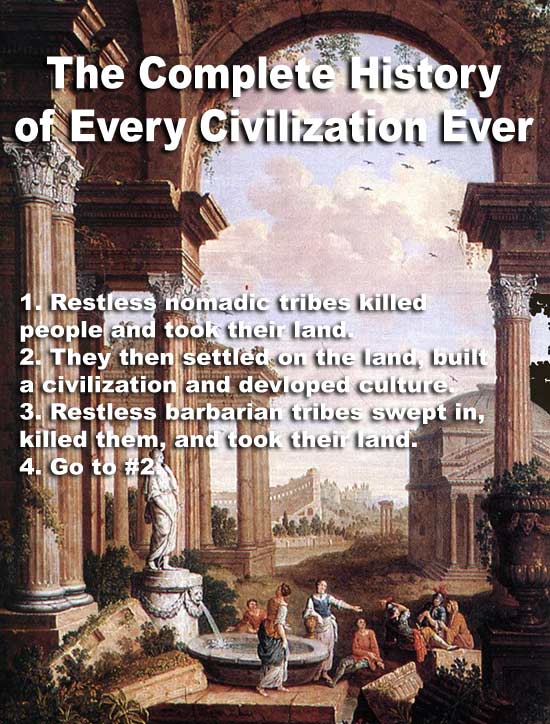
Complete Guide to History

The modern era isn’t fraught with such examples though, mostly because we’ve all just learned not to take blankets from strangers. But you’d be wrong to think that just because we’ve developed modern life, people have stopped trying to get land. There’s only one example of modern history that rests on something other than land, and that’s World War I, which rests entirely on stupidity, but ended up being a major land grab anyway.

Its aftermath, what I like to call World War II, rests almost entirely on the subject of getting land. Germany, the country which started the ill-fated endeavour because they couldn’t compare the number of factories they had relative to the United States, expressly stated this in their policy of Lebensraum. The Germans didn’t want a living room with nice sofas and such, they wanted room to expand their population. Because their citizens couldn’t put on a rubber, Germany invaded Czechoslovakia. Then Poland. At that point, why not try on Russia for size.

And of course let us not forget cleaning out the land they already had. Germany built death factories so they could cleanse what was already in their possession of the undesirable: Jews, Gypsies, Homosexuals, Retards, and assorted others. Then they built an economy on that so they could sell lampshades made of human skin and soap made from human fat. That’s German efficiency: take the land and make stuff out of the people you kill. The early Hebrews could have learned something from that if they had a time machine and their descendants weren’t being slaughtered by the millions. Hey, Abraham, they will number more than the stars, but they’re all going to get killed in really nasty ways.

These are just a few examples, but most of human history follows the same pattern. Whether it be Homo sapiens killing off Homo neanderthalensis, Hebrews taking a sliver of land by the sea, Normans snuffing out Britons, Maori shooting the hell out of the Chatham islanders, or Nazi Germany putting Europe to the flame, it all comes down to land. You might hear various things about Vietnam, or “no blood for oil,” but none of those things happen without the lust for land from one party or another. It all comes down to dirt, and the to the people who live on that dirt and the resources thriving on or buried under that dirt.

So the next time you read a history book, keep in mind that it’s all just an effort to grab land. When it all comes down to it, people are a lot like earthworms; we’re both just obsessed with dirt.


The Historigon: Gregor 2007

The Historigon

This Month in History:

  • 2006 AD- Only one month after being commissioned, NCV-738 U.S.S. William Henry Harrison sinks to the bottom of the Atlantic.
  • 2002 AD- Respect for the environment reaches an all-time high of .067% of the population.
  • 2000 AD- Thanks to the continued success of comedy, humorism is finally declared dead.
  • 1998 AD- In order to advance his post-The Wonder Years career, Josh “Paul Pfeiffer” Saviano, reinvents himself as shock rocker Marlene Berkowitz.
  • 1993 AD- A peanut allergy causing virus is perfected by the Walnut Council.
  • 1973 AD- Sloppy Whitehouse janitor Earl Shecky is added to Nixon’s enemy list.
  • 1950 AD- Timothy Dawson, father of three, comes home after a long day at the office and lights up his pipe.
  • 1918 AD- After tripping up in No Man’s Land, First Lieutenant Miles Raspail Thompson curses Joseph Glidden and his so-called “barbed-style wires.”
  • 1896 AD- After his horse dies miles from home in the freezing cold, junk man David Rosen of Detroit cuts her open and sleeps inside the carcass to keep warm. Years later a young filmmaker reads of this and includes it in one of his films.
  • 1776 AD- Tired and worn-out after a night of composing, Thomas Jefferson pens a silly little piece of writing that he calls “The Declaration of Indigestion.”
  • 1666 AD- As it is “The Year of the Beast,” John Fish sits in his wood bin, fingers in his ears, waiting for Armageddon.
  • 1492 AD- Spaniards arrive in North America to replace the ancient horse population which had died out thousands of years earlier.
  • 1330 AD- Shortly before the birth of future Shogun Ashikaga Yoshiakira, those near his mother hear screams of pain.
  • 1184 AD- After falling for the same trick eighty-six consecutive times, French Crusaders follow an apparently fleeing Muslim army into a narrow mountain pass, just in case it might actually work this time.
  • 1041 AD- Samuel Aba becomes king of Hungary, beginning over 900 years of the world not caring what happens in Hungary.
  • 863 AD- Gradu the Barber, in the first written account of the city of Smolensk, states that “it’s a one donkey town.”
  • 770 AD- Halfer the Blacksmith decides to start making horse shoes out of iron so he doesn’t have to see that annoying Lord Grefter and his snotty six-year old son so often.
  • 622 AD- Following in the foot steps of other religions of peace such as Judaism and Christianity, Muslims found their religion on the invasion and destruction of other lands and people.
  • 504 AD- The Mitriani, a long-lived alien race with a small population, land on a largish coral outcropping in the Pacific. Finding little in the way of intelligent life, they decide to have their equivalent of a can of soda before leaving. 1400 years later, Americans decide they really like Kwajalein Atoll.
  • 258 AD- Shortly before being declared emperor, Sun Xiu is frustrated by a commoner who can’t seem to carry a wooden pole through the gates of Hulin. Sun sticks a finger in his eye and lets out a yell, thus creating the action which was named for him: the shoe.
  • 112 AD- Dugongs invent spear technology and launch an invasion of what would become southern Malaysia. The invasion fails under mysterious circumstances.
  • 240 BC- Ctesibius of Alexandria invents a sub-orbital, pneumatic rocket, but accidentally pushes the improperly-labeled self-destruct lever, destroying the rocket and his engineering notes. At the same time as the explosion, Ctesibius invents the interface concept of labels.
  • 535 BC- Lao Tzu is the first philosopher to come up with the idea that everything, including one’s memories of the past, was created within the past five minutes. An intelligent friend slaps Lao across the face, ending the promulgation of this line of thought for hundreds of years.
  • 760 BC- Shortly before his death Alara, the king who united Nubia, looks over the sand and dust of his kingdom and starts to wonder why he would do such a thing.
  • 1001 BC- Local inhabitants, burdened by the fossils their people had collected while migrating throughout Africa, begin throwing them into Olduvai Gorge.
  • 1457 BC- Kiltumesh takes a break from the Battle of Megiddo to urinate and use a branch to relieve himself of the irritating itch on his back.
  • 1729 BC- Humming to himself while working on some pottery, Terah doesn’t notice Abraham, Lot, their families and their friends leaving for Canaan.
  • 6000 BC- Neanderthals found the Minoan Civilization.

March of Progress: Gregor 2007

Metal Rings Now Obsolete
In what is being hailed as a revolutionary breakthrough, technicians at Toledo’s Bester Labs were able to successfully attach plates to a metal ring. Also made of metal, the plates have now rendered plate-less metal rings completely obsolete. This is a major step forward in metal ring technology, an advance unequalled since metal rings were first developed in the early 1930s.

For decades, many in the metal ring industry had considered the addition of plates to be science fiction hokum, a belief which was dispelled in 1998 when metal ring technician Amanda Brock published a mathematical proof that plates would be possible, under certain, difficult to achieve conditions. Though many continued to debate the veracity of Brock’s claims, a few advanced labs began testing to determine if plates could be successfully added to metal rings.

After nine years, and fifteen billion dollars, Bester Labs managed to fulfill the dream of countless generations by adding plates to metal rings for the first time. “This signals the dawn of a new age,” said Assistant Ring Technician Tommy Branson. “With pluck, determination, and a few billion dollars, anything is possible, even plates on metal rings.”

The prototype metal ring with plates, dubbed EVX-17, will be on display at the Toledo Hall of Science until January.

Letters: Gregor 2007

Written Correspondences from Good Natured Gentlemen Who Have Read Our Previous Installments and Wish to Comment on Some Aspects Thereof

To Whom It May Concern,
I would like a job in either your production department or your chemical reclamation department. I am strong, smart, handsome, and virile. You may think these last two traits don’t really help all that much when it comes to reclaiming spent chemicals or producing a magazine, but I’ll let you in on a little secret: you’re probably not as handsome or virile as I am, so how would you know?
Ralph Fiennes
Franklin, TN

Dear Axes & Alleys,
Could you please print my letter asking my girlfriend to marry me? It was the most romantic thing I could think of. I hope she says yes.
Freddie McSwirley
Boston, MA

Dear Editors,
I loved your article on the number seventeen (Seventeen: A Brief History, Volume 456-BR8, Issue 02)! The best part was the bit with all the flags at the bottom, including that of my own homeland of Esperia. I’ve missed it so much since I moved to the United States, and it’s so rare that you see Esperian things in this country. Longa vivi Axes & Alleys.
Shovelilo Teni
Detroit, MI

Axes & Alleys,
The recent influx of Esperian terrorists to this nation is incredibly disturbing. It is my understanding that your publication is quite popular amongst them. Please be a true patriot and tell these readers of yours to go home.
Allison “The Admiral” Pfeffer
Bremen, Germany

Hey Editors,
What’s with Illinois, porn and astrology?
Eliza Rohr
Chicago, IL

Dear Axes & Alleys,
Did you know a really good way to use your magazine is as kindling for the fire used in the final step of making buckskin leather? It may seem highly unbelievable, but it’s true. I usually buy two copies, one for reading and one for putting in the bottom of the fire pit before I start the smoking process. It makes a nice, amber or yellowbrown patina on the skin, makes it incredibly pliable, and best of all is that perfuming agent you use in your dyes. No one knows my secret ingredient, so I’m selling an awful lot of moccasins, coats, and chaps. Thanks you guys!
Mark Frauenfelder
Los Angeles, CA

Dear Axes & Alleys,
We deeply regret the incident of last summer. Our inaction caused you and your neighbors outrageous inconvenience and serious discomfort during some of the hottest months of the year. The tepid response we first gave to the issue, as well as our disinformation campaign, did nothing to relieve you of the darkness, heat, and odoriferous conditions you experienced in your apartment for nine days. We are terribly sorry, and if there’s anything we can do to make it up to you, please let us know.
Kevin Burke
Chairman, President, and Chief Executive Officer,
Consolidated Edison
New York, NY

Dear Axes & Alleys,
Why have there been at most two references to Showtime Networks’ The L Word in your magazine? That’s hardly enough. You’ve mentioned Leisha Halley, of course, and I can’t but think that your article devoted to fire safety (Fire Safety Tips for the Home, Volume 456-BR7, Issue 18) was an allegory for the death of Dana in the third season. That’s it, though. No references to important main characters like Shane or Bette, no mention of backgrounders like Lara (she’s a hottie), or that transgender Max. I expect more The L Word references and fewer references to things like Blake’s 7 or the 12th season of The Tonight Show with Johnny Carson. I’ve certainly had enough of your theological diatribes.
Ilene Chaiken
West Hollywood, CA

Dear Axes & Alleys,
Why is it that the serious, professional architects always make fun on my designs for my the skyscraper I want to build. It’s call “The Chicago” and is a million miles high and bright orange in color. They always tell me that there’s no material with the tensile strength to enable the construction of a million mile tall skyscraper. That’s so unfair.
Michael Forks
Thaddigan, PA

Dear Sirs,
In your article “Alamo or Bust” your historians say that David “Davey” Crocket died at the Alamo, killed in battle by Mexican solidiers. What a crock. Everyone who has studied geometry knows that such a death would be impossible. No, it seems much more likely that he was killed by two alligators named Clem and Morris. Morris ate the top half, but didn’t eat the hat. Alligators don’t eat hats.
Laura Burbank,
Talisman, GA