What’s a Telenovela?

When I give you my money / I wanna hear you say what I want you to / And act like you mean it baby / or I won’t believe you.
Telenovela Star – Le Plum Deux

music review

I was not paid to write this review. It might seem that way because it’s glowing, but the truth is I really dig this record and I think you will, too. Now, most local bands I find intriguing see me at virtually every show they perform. Not so Telenovela Star. In the two years of their present incarnation, I’ve seen them twice; once at their debut in the trash can that is the Sibera club’s basement and once this past January at The Delancey, a wonderful club that also just happens to be in a basement.

Four years ago, when you could still enjoy a musical revue and a cigarette at the same time, I caught the previous iteration of the band, Telenovela. At the time the trio was two scruffy dudes on guitar and drums, and a chick with her hair in her face on bass. By the time I grabbed a friend for that Siberia show, two years had passed, they’d tacked “Star” onto their name and dropped the dudes. Here now was Telenovela Star with bassist and vocalist Hanna Klein, Nikkie McLeod beating the skins, and Maggie Argyros on guitar and vocals.

This past January, with a free Saturday in my pocket and braving arctic temperatures, I caught their Delancey show. There, one year after its release and directly from the band I received my first hard copy of their music: The Telenovela Star EP. Since then those tracks have accompanied me everywhere I go. I’ll tell you why.

Their vocal stylings aren’t spectacular and they’re not a flashy ensemble with themed outfits at every show or musicians who spout some bullshit concept when asked about their music. But, Telenovela Star is the epitome of “band.” Each member is a talent in their own right. No, they’re not virtuosi, but they are incredibly good. Few groups, live or recorded, possess their ability to play together, to sound like one instrument with purpose.

At the same time, their songwriting and musicality enable them to showcase one another individually. They’ll give the guitar space in one song, or emphasize the bass-percussion unit in another, or blend the instruments and vocals in such a way as to highlight the best of each. In many ways, each woman as an instrumentalist takes the styles of music prevalent around them and carries those styles forward in startling directions.

Often current guitarists are boring and uninventive. With this beautiful modern history of amazing players to learn from, you still don’t often hear great melodies or a good riff. Modern rockers present neither adaptation nor ornamentation. If you want to go local and find out for yourself, just search the rock section of MySpace, or turn to your favourite major music outlet and listen to what’s popular. It’s pathetic.

Maggie is none of these things, plus she’s from my own neighbourhood of Astoria. It’s sad that technical ability would be something notable merely for its presence, but I find it truly impressive. She’s not flashy, but her style is perfect both in and out of the context of the band. Her full-on guitar lines are hard and always to the point. And another thing: distortion. She doesn’t overdo it, she does it just right. I love distortion done just right.


telenovela star

Continue reading

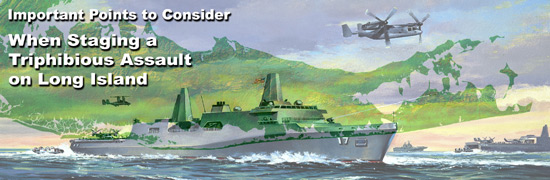
So You Want to Invade Long Island?

invasion

There is only one real reason you would attempt to land a large expeditionary force in Long Island, and that is to seize New York City and possibly the port facilities in Brooklyn and New Jersey. Therefore, the following ideas will assume that that is your goal and that to achieve that goal you would need at least an Army Group (let’s say five divisions plus support and transportation units) and a large fleet of transport vessels and escorts, including a carrier group and plentiful ground-support gunships or fixed-wing craft.

The best time for an invasion would be around late summer in order to have good weather conditions for an autumn campaign. Ideally, you want to be able to seize control of New York City before the deep winter begins in January. The urban environment would provide excellent winter billets for a large army group as well as easy access to food and fuel supplies. A bitterly cold winter would be a good time for digging in, destroying bridges and establishing a defence perimeter. Snow and other adverse weather would make major sorties by enemy troops into your position difficult at best and will help to prevent overflights of your airspace by enemy units.

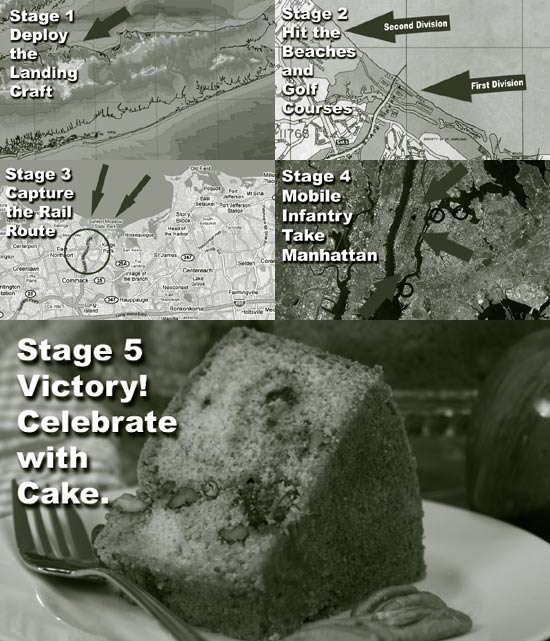
The first wave off the LSTs will need to be infantry or possibly marines. Thus, the Army Group should be composed of two divisions of infantry, two divisions of mobile infantry and one armoured division. The first division will secure the beachhead and allow time for some heavier equipment to be brought up. While armour will be important to repel any heavy counter attack, for the most part heavy armour will be a hindrance in the densely populated urban areas. It would be best to have light tanks and self-propelled artillery, with a few heavier tanks available to conduct coordinated attacks on strong enemy positions.

An ideal landing spot can be found just east of Northport Bay at the adjacent Crab Meadow Park, Indian Hills Country Club and Sunken Meadow State Park. While the south-eastern portion of this coast-line is marshy, the north western areas, around the golf-courses, have large open areas and massive parking lots just off the beach that will allow for easy movement of heavy equipment. Once a beachhead is established, smaller elements will need to move north to capture the US Coastguard Station on Duck Harbour Island, while other units will move south down Fort Salonga Road to secure the rail station and lines off E. Northport Road in Kings Park.

Sunday the 19th of August would be a good D-Day, as the tide will be almost seven feet just after 4am which will allow your first wave LSTs to get fairly close in to the shore. Within a few hours, once a beachhead and foothold are established, elements of one mobile infantry division will seize Macarthur airport, while the armour and other mobile infantry move via the Long Island Expressway through to the west before splitting up to take control of the ConEdison power plant and LaGuardia Airport on the north shore, as well as the shipping facilities located in New York Harbour. Engineers and support troops can then be brought up to the airports, allowing supply and reinforcement to be deployed by long-range transport aircraft.

invasion plan

Air support will be utilized to destroy bridges, rails and roadways leading into New York City, especially those that lead across the Hudson River, while fleet based gunships can be used for recon as well harassment of any enemy troop formations in the open.

In this campaign, the most important thing to remember is speed; get ashore, find your means of transport and move west. Only key points like airfields and port facilities need to be held. Other infrastructure can be destroyed, though it will be important to minimize collateral damage and civilian casualties.

It is likely that there would be little resistance, allowing for high mobility. Your forces should be able to reach the East River within three days and begin setting up a first prepared position near the Hell’s Gate bridge in north-west Queens. This is the only rail bridge between Long Island and the mainland that is strong enough to carry your heavy armour. These, acting in concert with mobile infantry and air support, will be able flank north into the Bronx, to surround the island of Manhattan. With all automotive bridges and tunnels bombed, Manhattan will be effectively isolated. Heavy air support, operating from LaGuardia can establish air superiority over the harbour, allowing ships to move up the Hudson.

At this point, the civic leaders of Manhattan should be offered the choice of surrendering the city without bloodshed. This would be ideal, as the close, urban areas of Manhattan would make for chaotic CQC, which would make air or artillery support impossible. Should the city resist, it will be necessary to invade. This will slow you down. Two to three weeks of shelling, coupled with air bombardment and sorties by air cavalry troops will weaken the city and its infrastructure.

There should be few enemy troops in New York City, though there may be a large, but poorly armed and disorganized insurgency. One solution to this problem would be to order a civilian evacuation; round up all the citizens and force them to march along all major roads out of the city. Not only will this clear out many insurgents and make them more easy to identify, it will also choke the roads with refugees, delaying any enemy counterattack.

At this point you will have succeeded in your invasion. Congratulations, you have conquered New York City. Secure all important infrastructure like power plants, storage depots and communications centers and procure supplies and billets for your troops. With New York’s harbour and airports secured, the Theatre C-in-C will be able move more reinforcements and supplies with ease. Now that your objective has been met, you should probably discuss this with the Theatre Commander and find out the best way to proceed.

Historigon: Aphros 2007

Historigon

During This Month in History:

2004 AD: Christian radio shock jock Clive van Wallen offends his listeners by having an unmarried couple who engage in intercourse with each other on his show.

2001 AD: Two praying mantises in the jungles of Brazil discover too late the folly of lesbian intercourse in their species.

1999 AD: Due to a typo in a company memo, Innetech programmers accidentally upgrade their banking software for the Y3K changeover.

1995 AD: Alan Greenspan spots a penny on 3rd Avenue but decides to leave it in circulation.

1976 AD: Gerald Ford continues to look and act like a high school football player.

1957 AD: The Inklings, an African-American Doo-Wop ensemble, record the first-ever heavy metal record. Unfortunately, the master recordings are lost in an office fire.

1945 AD: Though Isoku does learn that WWII has ended, as a joke, he decides to stay hidden in the jungles of Guam for thirty four years.

1918 AD: Former American President Theodore Roosevelt pens an editorial in the Cincinnati Sun-Standard expounding upon the benefits of jogging in place.

1904 AD: Using his cunning, and almost mystic powers, Rasputin convinces Dmetri to do the dishes, even though it was clearly Rasputin’s turn.

1891 AD :Elderly chimney sweep Dick Troppin dies of black lung disease, but not before passing on his vast knowledge to the young Pip.

1854 AD: Lt. George Herbert, the 626th member of Light Brigade, who missed the charge due to a broken leg, asks Tennyson to mention him in the poem anyway.

1775 AD: Some Spanish guys pass out from overconsumption of pulque, founding the town of Tucson, Arizona.

1650 AD: After banning Christmas, Lord Protector Cromwell attempts to appease the people by creating Puritan Day; a day of fasting, prayer, and self:denial, featuring twenty three and a half hours of church.

1401 AD: Klaus Störtebeker, history’s first and only German pirate, lands and attacks a hedge in a drunken frenzy.

1327 AD: Mongol warriors build a tiny, four foot pyramid of mouse heads.

1275 AD :While strolling past the court jester, Edward Longshanks inspires England’s first stiltwalker.

999 AD: Aelfrydd Vhesther of Wales builds the world’s largest sod mound at the time.

726 AD: Emperor Seibu of Japan sees two men wrestling and decides he’d like it better if they were overweight and mostly nude.

315 AD: In preparation of their slaughter of the population of Alexandria, Caracalla’s troops burn a model made of straw and mud.

67 AD: St. Peter complains that all the blood is rushing to his head and that he’s really uncomfortable. The Roman guards ignore him.

178 BC: In response to Rome threatening them with invasion if they don’t stop bugging the Lycians, the people of Rhodes join together on the beach for a group raspberry as the Roman envoy arrives.

322 BC: Ptolemy has a wonderful robe made for him in Memphis.

420 BC: Herodotus completes his nine volume History of Footwear, but no copies survive to this day.

500 BC : Gautama has sex with his wife, though only in moderation.

2600 BC: Amahretep the Sun Priest, ignoring instructions, just cuts open a corpse’s head to scoop the brains out.

5200 BC: Arshut, the world’s first homosexual, wishes that someone else was gay too.

10,845 BC: After trading a hunter a leopard skin for a night with Nambar the Large Bosomed, Nam the Prostitute Handler becomes the first pimp.

43, 003 BC: No one in the clan suspects that Furdu is secretly hoarding coconuts.