The Dangers of Time Travel

The Dangers of Time Travel

Time travel is not, and may never be, possible. However, a committee at the prestigious Flagstaff Institute of Theoretical Physics has released a new report detailing just how stupidly dangerous travel to the past or future may be. The report is of special concern to our growing corps of chrononauts.

“If you go back in time,” stated Dr. Steven Hawkins at a press conference held in the Luau Room of the Particle Physics Research Institute and Brothel “you may affect causality in numerous ways; say by killing your parents before they screw you into existence, or rolling your ATV over the sherwlike creatures which gave rise to all modern-day mammals.”

However, Dr. Hawkins warns against an even greater threat. “The real danger isn’t from paradoxes. It’s from disease.”

The group warned that the past is rife with all manner of pestilence, disease, and infections including, but not limited to, every disease ever. The FITP committee hypothesizes that a time traveler venturing, for instance, to 25 AD to prevent the Crucifixion would perhaps succumb to amoebic dysentery within two days before he could prevent the salvation of mankind.

“It wouldn’t be a pretty death either,” stated Hawkins. “Even the 19th and early 20th Centuries aren’t safe. We advise not venturing back more than a couple of decades if time travel is ever invented. Which it won’t be, because it’s not possible.”

According to a high-level official at NACTA, the National American Chronambulatory Travel Administration, the report is of grave concern to the nation’s fourth largest department. Both the Armstrong Administration and NACTA refused to comment for this article.

So, while it may be interesting to see what Napoleon could have done with machine guns and a logistics planning computer, any chrononaut who heads to Austerlitz with a crate Kalashnikovs and a planeload of MREs is going to be too distracted by small pox, diphtheria or cholera to enjoy the battle. Furthermore, photographs of Napoleon with a mustache could be taken, which would demoralize modern-day Corsicans.

The future may be safe, though people in the future will probably imprison and quarantine you before you even have time to look up your great, great grandchildren in some sort of futuristic phone book. You’d actually be quite easy for a group of futuristic, leopard-human hybrids to capture and we imagine they will take many photographs of you with their prosthetic audio-visual communication hands.

“If you have to go back, say to prevent Buddhism or something,” Hawkins concludes “it would be best to wear a containment suit that you burn as soon as you return to the present. Of course, you won’t ever do that, because time travel isn’t possible.”

News of the World: The Ants’ Spaceship

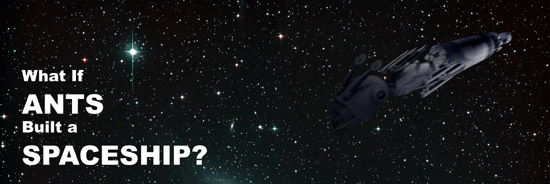
ant spaceship

If ants built space ships most people assume they wouldn’t be very big because ants are quite small. Formic spaceships wouldn’t be as tiny as many assume, though, because ant colonies can get to be pretty large, covering acres of land to depths of several feet. Still, a spaceship built by a colony of ants wouldn’t be terribly huge.

The traditional image of ants created through science media is usually one of strife involving raids, slavery, and death. What if the space race brought the colonies together? I like to imagine that a space program would bring the entire race of ants together in a type of social insect utopia. In that case they would need a bigger ship.

A natural design for such a ship would be the shape of an ant itself, stylized of course to avoid infringing on the sensibilities of any species. From antennae to the end of the abdomen it would measure perhaps 12.7 kilometers long. The widest diameter of the ship would be across the abdomen, at around 6.1 kilometers.

The internal superstructure of the abdomen, legs, thorax, and head are to consist of enclosures which can be adjusted to the direction of thrust, providing a simulation of gravity. When the ship is in free-fall, the carpeted hallways will provide gripping points for the ants.

Propulsion comes through a hydrogen-fueled Bussard ramjet. The long, protruding antennae of the ship and the mandibles located at the front of the head are to produce the field for the craft’s ramjet. Interstellar hydrogen is to be guided through the mandibles and into the mouth, through the central fusion mass conduit modeled on an ant’s gut, and finally into the six fusion propulsion systems located at the tip of each of the leg structures. The fusion system will then provide thrust and power for the ship.

Biomass for the ants’ consumption would be located throughout the abdomen. Special fungus and aphid farms will be installed towards the front of this section for those species who require them. Otherwise the storage facilities will contain vegetable matter.

The thorax of the ship would contain gigantic environmental systems to handle the air and water needs of the ant colonies. The air processors will use oxygen and nitrogen generated by the biomass in the abdomen to supply the vast majority of atmosphere for the rest of the ship, while secondary storage and generation equipment remains on permanent stand-by in case of emergency. Since ants get most of their water from food, the water reclamation system required is much simpler as it is mostly there for the benefit of the biomass.

The filtration and recycling system is to be connected to the biomass storage facility through an open circulation system, constantly cycling water from the abdomen to the processing equipment and back. Connected to the fusion power plant at the rear of the abdomen through a set of tracheae, electrical distribution can be efficiently routed throughout the ship without sacrificing living or storage space. It can then be used as a secondary source for heating due to its proximity to the heating system.

The heating system will rely both on electricity coming from the fusion plant and the warmth from the moist, hot air created by the decomposition of vegetable matter in the fungus farms. After reaching the distribution junction, this air is then passed through the environmental system to extract its moisture, whence it passes to all points beyond.

Living space for the individual colonies will be located in the remaining areas of the abdomen. The fore section of the abdomen will feature environments dedicated mainly to those species residing in tropical and desert biomes, as these decks are closest to the heat distribution system. The top-most section will contain species from dry temperate locations, while the aft decks will contain species from wet temperate locations and those from cold or sub-arctic regions. Colonies residing near the engineering centers of the thorax will be those from environmental regions representing an extreme mix of temperatures and moistures.

The ship’s head is, naturally, to be the command and control centre. The lower portion will ensconce the main computer and auxiliary control systems (such as the Bussard field adjustment computer and environmental control). The upper portion, complete with multi-faceted view screens and other sensors built into the eyes, is the Bridge, which will be staffed by specially grown controller and navigator drones.

Astrogation and propulsion would be controlled directly from the Bridge. At the same time, command officer drones can issue orders to their various colonies through pheromone disseminating pneumatic tubes specific to each species. The pneumatic system carries a control pheromone to the appropriate colony located in the abdomen. From there a pheromone disbursement officer carries the message throughout the colony.

Colony Queens would spend the majority of their time at the Queen’s Deck, located in the bottom aft section of the abdomen, directly above the main docking bay. Most eggs will be kept in the temperature controlled storage decks, while some will be carried directly to the docking bay for placement on the landing pods used for colonizing suitable planets. The single airlock located in the extreme aft section allows for launching colonization pods, as well as for the jettisoning of trash and waste.

As you can see, a multi-species advanced interstellar craft for ants is a feasible idea for the most part. There are some problems surrounding ant cognition, manufacturing methods, and economic systems, but these can be overcome in time. Remember that Mankind took only six decades to advance from flight to space travel, and that ants have already been flying for millions of years.

After coming along with me on this beautiful journey into the possible, don’t you also think it would be wonderful for ants to reach for the stars, come together in filial admiration, and build a fancy, ant-shaped spaceship? I thought you would.


Letters: Mapril 2007

Written correspondences from good natured gentlemen who have read our previous installments and wish to comment on some aspects thereof.

To Whom It May Concern,
Your article on college by Garnet “Collegebound” Bruell (My Essay About College, Volume 456-BR7, Issue 14) is full of crap. I met Garnet at the campus diner the other day and he’s nothing like he describes in the essay. I asked him about various colours and, you know what? He doesn’t like colours. When I asked him if he wanted to share my sandwich with me he said he wasn’t hungry, contradicting his statement that he likes to eat! How can you print such lies?
Provost Teresa A. Sullivan
University of Michigan, MI

To Whom it May Concern,
Thank you for your interest in the papacy and in the Holy Catholic Church. While the I do enjoy meeting and speaking with Catholics the world over, I am often too busy with prayers and services to answer each letter personally. Please continuing partaking in the Seven Sacraments and thank you for your letter.
Love in Christ Through an Intermediary,
Pope Benedict XVI
Vatican City

To the Editors of Axes & Alleys,
There are several major problems with your so-called comic in the last issue. First of all, the American flag patch is on the left arm of an astronaut’s suit, not the right as depicted in this illustration. Secondly, astronaut helmets do not feature any jutting antennae, as these would be too delicate for an EVA and may snag on something, jeopardizing communication with the shuttle or lander. Third, there is no mission patch present on either the chest or shoulder. Also, there is no such thing as aliens. At least not like they’re depicted here. Please do your research before publishing this nonsense. It perpetuates ignorance and could cause children to lose interest in manned space exploration programs.
Catharine Coleman
Cape Kennedy, FL

Dear Mrs. Occupant,
Would you be interested in learning more about brass? Send away today for your free brass information pamphlet from the Brass Advisory Council.
The Brass Advisory Council
Grand Rapids, MI

Dear Editors,
Why is that your magazine is only scratch-and-sniff in the Czech Republic Edition? Here in Poprad, we can only get the Slovakia Edition and are hence unable to scratch or sniff anything at all. Our olfactory senses have become dulled. Back before the fall of the Iron Curtain, we used to be able to get the Czechoslovakia Edition, which was edited by the Party, but at least could be smelled. Why have you granted only the Czech Republic with the scintillating world of scents? Also, could you please start reprinting the Ruthania Edition?
Bost Malichi
Poprad, Slovakia

Dear Axes & Alleys,
Does your magazine have anything to do with Peruvian supermodel Alexis Andaliz? She is really hot and has a name similar to that of your magazine. Is this just a coincidence? Because she’s totally hot. I even have her picture as my desktop wallpaper.
Maria Thymagissine
Llanddewi Brefi, UK

Dear Axes & Alleys,
The contents of my pocket are: two quarters totaling fifty cents, a safety pin, and one glove.
Sincerely,
Henrietta Stevenson
Glendale, SC

Dear Delores R. Grunion,
My name is Billy Green and I am a ten year old boy with a horrible disease called Billy Green Syndrome. This disease is genetic and was named after my father. The doctors said that it was incurable and, like my father, I would die before the age of eleven. But then last night Jesus, and his brother James, appeared to me in a dream and told me that I would be miraculously cured, but if only I would write a letter to your magazine. Jesus, and his brother James, said that if you refused to print my letter then I would be miraculously cured and everything would be alright and my mommy would stop crying. So please don’t print this letter or allow it to appear in your magazine. I don’t want to die.
Billy Thompson Jr.,
Harrisburg, PA

To the Editors,
People for the Ethical Treatment of Animals (PETA) is the world’s largest animal rights organization, with more than 1.6 million members and supporters dedicated to animal protection. This letter concerns your recent glorification of the mistreatment of animals at Magic Muffin’s Research Campus in Monrovia, MV (Mammals Move Muffins, Volume 456-BR8 Issue 02). Numerous animals, including snakes, monkeys and sloths have been subjected to cruel treatment in a salacious effort to “improve” human life. On behalf of our members and supporters in Montsylvania, we respectfully ask that you print a retraction of your propaganda piece for the animal slavery industry and publish an article provided by our media department: The Immorality of Muffin Industrialization and Animals.
Dan Paden, Researcher
Domestic Animal and Wildlife Rescue & Information Department, PETA