
Enema of the State of Utah

blink1

Why Mormonism is Not the Least Bit Like Blink-182. At All.

Professors Robert Burg and Dr. David Louzecky of the University of Wisconsin, Sheboygan, published a paper in this month’s History entitled “Enema of the State of Utah” in which they purport to lay bare the deep connections between The Church of Jesus Christ of Latter Day Saints and the now-defunct pop-punk band Blink-182. This preposterous position is indefensible and ridiculous.

In their introduction, the “professors” state that “the connections between the Restoration movement in 19th Century America and the late-90s emergence of the pop-punk phenomenon are obvious.” If any such connections were so obvious Dr. Louzecky (who obviously penned this scabrous portion of the paper), why didn’t anyone point this out earlier?

They go on to outline the various groups struggling for existence during the Restoration and compare this state of affairs with that record labels faced in the 1990s in attempting to “increase sales by meeting the perceived or manufactured demand for pop-punk music by offering up dozens of such instrumental groups to consumers.”

One might as well compare any group of things struggling for supremacy to any other. If we’re to play so loose with logic, the pop-punk era also bears a striking, whiz bang similarity American politics immediately preceding the Civil War, the struggle for control of the Muslim world in the 7th Century, and the Warring States period of Chinese history. In that case MxPx must be pretty damn similar to the Wei, right? Wrong.

In order to bolster these specious claims, Burg and Louzecky point out that Blink-182 and Mormonism were the “sole major successes of either movement.” This is patently false. Mormonism is only arguably a member of the Restoration movement as its initial history involves little time spent in the influential East of the United States and the promulgation of a completely new testament, something virtually unheard of amongst other Restoration congregations.

By contrast, Blink-182 was almost immediately at the forefront of the pop-punk in the late-90s, inciting the release of other acts such as Good Charlotte and Sum 41, but followed in the footsteps of groundbreakers Green Day and The Offspring. Some would even produce lacklustre punk pioneers The Ramones at starting end of pop-punk history.

In response to a referee’s critique similar to this one, Professor Burg points out that Mormonism also had hangers on in the form of the Churches of Christ and the Disciples of Christ as well as antecedents in the Anabaptists. This immediately disproves the previous point as both churches exist today with memberships near three million worldwide. While the Anabaptists no longer exist, neither do The Ramones. I’m still outraged that such sloppy research and thinking made its way through the initial review process of a major publication.

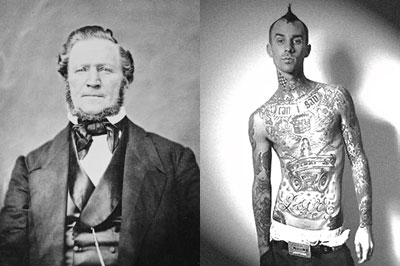
Taking this preposterousness further, the good “professors” compare the physical appearance of Blink-182 drummer Travis Barker to that of Latter Day Saint second-stringer Brigham Young. Take a look for yourself.
Professors Robert Burg and Dr. David Louzecky of the University of Wisconsin, Sheboygan, published a paper in this month’s History entitled “Enema of the State of Utah” in which they purport to lay bare the deep connections between The Church of Jesus Christ of Latter Day Saints and the now-defunct pop-punk band Blink-182. This preposterous position is indefensible and ridiculous.

In their introduction, the “professors” state that “the connections between the Restoration movement in 19th Century America and the late-90s emergence of the pop-punk phenomenon are obvious.” If any such connections were so obvious Dr. Louzecky (who obviously penned this scabrous portion of the paper), why didn’t anyone point this out earlier?

They go on to outline the various groups struggling for existence during the Restoration and compare this state of affairs with that record labels faced in the 1990s in attempting to “increase sales by meeting the perceived or manufactured demand for pop-punk music by offering up dozens of such instrumental groups to consumers.”

One might as well compare any group of things struggling for supremacy to any other. If we’re to play so loose with logic, the pop-punk era also bears a striking, whiz bang similarity American politics immediately preceding the Civil War, the struggle for control of the Muslim world in the 7th Century, and the Warring States period of Chinese history. In that case MxPx must be pretty damn similar to the Wei, right? Wrong.

In order to bolster these specious claims, Burg and Louzecky point out that Blink-182 and Mormonism were the “sole major successes of either movement.” This is patently false. Mormonism is only arguably a member of the Restoration movement as its initial history involves little time spent in the influential East of the United States and the promulgation of a completely new testament, something virtually unheard of amongst other Restoration congregations.

By contrast, Blink-182 was almost immediately at the forefront of the pop-punk in the late-90s, inciting the release of other acts such as Good Charlotte and Sum 41, but followed in the footsteps of groundbreakers Green Day and The Offspring. Some would even produce lacklustre punk pioneers The Ramones at starting end of pop-punk history.

In response to a referee’s critique similar to this one, Professor Burg points out that Mormonism also had hangers on in the form of the Churches of Christ and the Disciples of Christ as well as antecedents in the Anabaptists. This immediately disproves the previous point as both churches exist today with memberships near three million worldwide. While the Anabaptists no longer exist, neither do The Ramones. I’m still outraged that such sloppy research and thinking made its way through the initial review process of a major publication.

Taking this preposterousness further, the good “professors” compare the physical appearance of Blink-182 drummer Travis Barker to that of Latter Day Saint second-stringer Brigham Young. Take a look for yourself.

blink1

Clearly they’re both unattractive, though with a quite-surprising glint of intelligence in their eyes. However, the similarity ends there. For instance, Brigham Young wears clothes. Travis Barker can’t even be bothered to wear a belt.

Of course, the pair have left their most disgusting and mendacious pronouncement buried in an unassuming paragraph at the end of the paper on production values and land acquisition inspired by God. It is well-known that one of the tenets of the Latter Day Saints was the revelation of the Book of Mormon to Joseph Smith by the Angel Moroni.

In what is clearly a fiction created by Burg, it is unconvincingly shown that the angel and Enema of the State producer Jerry Finn share “remarkable and definite similarities.” These similarities include the fact that Moroni was a “record producer” because he came up with golden tablets inscribed with writing. How far can you stretch the truth, really?

You can find out by reading “Enema of the State of Utah,” which has already and unfortunately sparked discussion nationwide. Water cooler talk, local television news broadcasts, even editorials in free, weekly rags are expounding on the paper. One would hope such discussion casts a cold eye on the claims of Burg and Louzecky. Even the motivations of the two men are suspect, as I leave you with this statement from a KKBC-Kalisotta Public Radio interview with Louzecky.

“Hopefully the paper’s publication will bring in some big donors so we can get one of those nice, self-serve pop fountains in the Café.”

By Art Gomez, Associate Professor of Paramycology at the Pendergast Institute. Mr. Gomez is Chairman of the U.S. Thinking Committee, Vice-Admiral of the Civilian Naval Corps and a member of the American Historical Association. While born under the sign of Aries, he does not believe in or espouse astrology of any kind.


The Historigon: Fabuly 2007

The Historigon
This Month in History:

2006 AD: Robert Mugabe, President of Zimbabwe, plans to spend $4 million to build a museum dedicated to his underpants, but later decides to build a museum about everything Robert Mugabe instead.

2000 AD: After months of research, a successful formula is developed, allowing Wow™ detergent to leave colours 20% brighter.

1971 AD: The first video game, Immobile Square, is released to mixed reviews.

1944 AD: Scientists at Los Alamos National Laboratory are disappointed to discover that radiation exposure causes only crippling illness, ending the US Army’s Super-Soldier project.

1904 AD: Albert Einstein devises a clever way of moving up from 3rd Class patent clerk to 2nd Class patent clerk, thus getting a modest increase in salary.

1809 AD: Washtub technology is advanced by Hubert Smyles of Tennessee, who attaches a primitive splash guard to his tub.

1798 AD: Carthage, NY founded by Hannibal Johnson.

1783 AD: Captain Cook discovers the aptly-named June 3rd Island.

1353 AD: Noted Muslim traveler Ibn Battuta publishes what is regarded as a prototype for this very column, The Allah is Great Prism of Past Events.

1010 AD: Never one to be upstaged by Canute, King Edfald of Mercia orders his archers to shoot up at the Moon for a while.

814 AD: In a dispute over iconoclasm Nicephorus, Patriarch of Constantinople, excommunicates Emperor Leo V the Armenian. Leo responds by smashing an icon of Saint Basil the Great over Nicephorus’ head.

708 AD: Duke Drogo of Champagne dies after being knocked unconscious in one of the region’s first attempts at carbonating its famous wine. Innovation in this area is stifled for another 800 years as a result.

538 AD: Justinian issues the Edict of Sardinia, declaring that the Empire should slowly collapse over the next thousand years.

14 AD: Gaius Julius Caesar Octavianus, Caesar Augustus to his friends, realizes during a severe bout of diarrhea that he should probably have his grandson Agrippa murdered.

100 BC: Due to an accidental mistranslation, the author of 1 and 2 Maccabees unknowingly ascribes the exploits of the extremely lost Celtic clan MacCabe to a local Judean family.

456 BC: Athenian student Daramenaxos suggests adding a new element: Mud. Others explain that mud is just a combination of the known elements Earth and Water.

600 BC: An insane traveler from Africa arrives in Greece mumbling fantastic stories about talking animals doing nasty things to each other. Aesop writes them down and cleans them up a bit.

1258 BC: An accidental confluence of sea turtles in the Caribbean, if viewed from the air, spells out the first three items on the menu of McClatchy’s Fried House in Plenary, AL.

1958 AD. If viewed from the shore it spells nothing.

2944 BC: Yup, the Chinese record another comet appearing in the sky.

6000 BC: New Guinean highlander Rut discovers an exciting new recipe for taro dip. Later at the dinner party everyone is wowed.

8122 BC: The forebears of Jericho figure out how to make fake rocks and then stack them to create leaky homes and a wall. The latter falls down at a rather inopportune time about 2500 years later.

11,001 BC: Humans arrive in what will become Argentina, but are too tired to leave.

16,000 BC: Thanks to the warming of the Earth and the end of the most recent Ice Age, Liffdon is pleased to find his hovel is now a hundred paces closer to the water supply.

853, 000 BC: Nugar and Fipo discover that badger tastes much better than aardvark.

News of the World: Fabuly 2007

News From Around Our World (The Earth)

Marseilles, France– the Botot company released its new dental product, Nano Floss, which contains billions of nanites for easier dental hygiene. Test subjects are also reported to have responded more readily to Botot product advertisement.

Nurby Province, Angina
– The crop-duster strike has continued into its third week, as farmers walked away from the bargaining table over he issue of a proposed contractual wing allotment.

Casablanca, Morocco– Mohamed bin Alamad has officially announced that his store will offer special discounts as part of a sales promotion.

Berlin, Germany– Federal government officials announced the allocation of 280 million euros to the national defense budget, though some opposition members opposed the spending of over half the allotment on Das kriegerhosen, the now-infamous German armored trousers.

Rome, Italy– Breaking their own record by over seven hours, the Italians have succeeded in having three governments fail in a single day.

London, England– P.M. Tony Blair announced that, upon retiring from politics, he is going to focus on selling off his warehouse full of 18,003 wax replicas of the Great Wall of China, and stated that he would sweeten the offer by throwing in a free tea cozy.

Esperon, Esperia– A study has found that average lawn size in the small state has decreased by 4% over the past decade.

Washington D.C., USA– President Armstrong wowed the White House press corps when he outlined his new energy policy while riding a unicycle.

St. Thaddeus, VI– After last month’s “Lobby Incident,” officials have banned the importation of woven baskets.

Fetterburg, Accadia, USA– Hours after concrete was poured for the new sidewalk on the south side of Lading St. between the 200 block and the 300 block, neighbourhood children vandalized the unset pavement with various ribald phrases. Many contained misspellings.

Al Fashir, Sudan– The European Union began L’Operation Porc-épic, a triphibious assault intended to bring about and end to the country’s multiple humanitarian crises and attempt to clean up the mess created by many of its member states’ colonial pasts.

Fyrine IV– A member of a species later known as “mock turtle” by fighter pilot Willis Davidge, is struck by a meteorite.

Camp Kalisotta, Kalisotta, USA– The last United States Army Air Corps air base closes down. Camp Kalisotta, which spent over 60 years manufacturing balsa wood models for use in table top maps, was closed due to advances in technology and the creation of the United States Air Force.

Bishkek, Kyrgyzstan– Krembik Daglayev has decided to stop farming sugar beets so that he can save enough money to purchase a tractor.

Ashville, North Carolina, USA
– Incidents of the use of “Ashvegas, North Kakalaka,” the local colloquial term for the area, have decreased 25%.

Fitzroy, Melbourne, Australia– Roadwork on Bennet St. will continue for at least two more weeks, as crews work around the clock to repair several large pot holes.

Outer Antabia– Ethnic tensions between the Oato and the ruling Minanese have boiled over after ping pong star Ut Myo was caught cheating at a recent exhibition match.

Tokyo, Japan, Sinonipponesia– The Kyasho Concern has unveiled its next generation of androids. The robots can not only recognize facial expressions, but can also climb stairs, sort boxes, catch Frisbees and imitate Johnny Carson.

Diego Garcia, British Indian Ocean Territory– Strange, batlike vehicles have been seen flying over the island. This is the 6000th such incident since the United States began basing B2 stealth bombers on the island.

Epidamnus, Illyria– Thousands of protesters marched through the provincial capital of Epidamnus to protest the country’s moratorium on shoelaces, which was initiated after a severe shortage of those little plastic caps that go on the ends.

Sao Paolo, Brazil– The Sao Paolo city council enacted public decency legislation outlawing the wearing of bikinis and offering a 7 Real bonus to those choosing to wear micro-bikinis.

Luganville, Espiritu Santu, Vanuatu– The Value Added Tax was increased to 13% after a restructuring of the department handling import collections duties which combined that department with the country’s internal revenue services. An extra $477 per year in income is expected.

Jakarta, Indonesia, Sinonipponesia– In an effort to increase their country’s prestige, citizens have taken President Susilo Bambang Ydhoyono’s advice and dug canals across promontories in the country, raising its total number of islands from approximately 17,500 to 22,300.

Bogotá, Colombia– The popular restaurant Umberto’s has added a new menu item which one diner described as a “kind of double taco.”

The March of Progress: Fabuly 2007

Release of the Picturenary!

picturnary

Every library contains a dictionary, as do many homes and bookshops. And why not? It’s a useful thing, a dictionary, for it lists and defines every last word in the English language. Should you want to know what a word means, how to pronounce it, its category or origin, you need only consult a dictionary. But what about pictures?

Finding information on pictures has always been a difficult task, made perhaps more difficult by the lack of suitable reference materials. This week that all changed as the Movable Type Printing Company announced the publication of the first eight volumes of the long-awaited Picturenary.

Once completed, the multi-volume work will show, with accompanying information and learned commentary, every picture in existence; including photographs, drawings, mosaics, etchings and napkin doodles.

While sought after by several large reference collections, pre-release sales of the Picturenary have been far below expectations. In response to the slow sales, Movable Type Printing announced that they would speed up production; releasing three volumes per year, instead of the two planned.

The currently available eight volumes contain some 43,000 pictures, all of them of aardvarks, the city of Aachen or men named Aaron. By 2012, the Picturenary should move forward into pictures of abacuses and Abbasids. . Photographs of the letter A will be saved for a special series of volumes featuring pictures of words and a series of special volumes have been set aside for abstract art which will include multitudinous interpretations of the work.

Picturenary editor Horvald Tomlinsson was taken aback when asked about the recursive problem of the Picturenary. That is, that for each image shown, a new copy of the image is created requiring another entry in the Picturenary. Tomlinsson responded that perhaps a blue-ribbon panel could study the subject, or the internet could help.

As part of the announcement, Movable Type Printing has requested that all people in the world send in copies of their snap-shots and vacation pictures, especially if they are named Abbey or have recently visited an abbey.


The Sordid History of the Picturenary!

Since the first Cro-Magnon men and women wrecked the cave walls at Lascaux with their graffiti of bison, mankind has dreamed of having a Picturenary. The first attempt to catalogue all known pictures was undertaken in 215 B.C. when Chinese Emperor Chin ordered his artisans to create ceramic miniatures of all known statuary. Unfortunately, Emperor Chin died before the project was completed and it was abandoned during the Great Han Pottery Destruction.

Thousands of miles away and hundreds of years later, the Council of Nicea planned to create a collection of all known pictures of Christ and the Disciples, to act as a companion book to the standardized Bible. This effort was abandoned when the Council of Hippo declared The Pictoriam to be a route to the sinful worship of graven images.

In the early 19th Century, Frenchman Joseph Nicéphore Niépce became the first person ever to successfully compile all known photographs when he placed the first photograph on his desk.

The Picturenary’s only modern antecedent was a DARPA project begun in 1972. The effort relied on creating a miniature black hole in the belief that an object of infinite mass would contain infinite information. Unfortunately the project was found to be missing at least 433 entries after a project scientist looked up a pair of drawings his son had made as a child and found them absent.

It wasn’t until 1998 that an ambitious young editor at Movable Type Printing, a Daniel Bester Inc. company, first began the modern Picturenary, when his collection of pornographic images won the Nobel Prize for Photography Accumulation. And the rest, is history, or more accurately, the rest is current events.