Book Review

book review

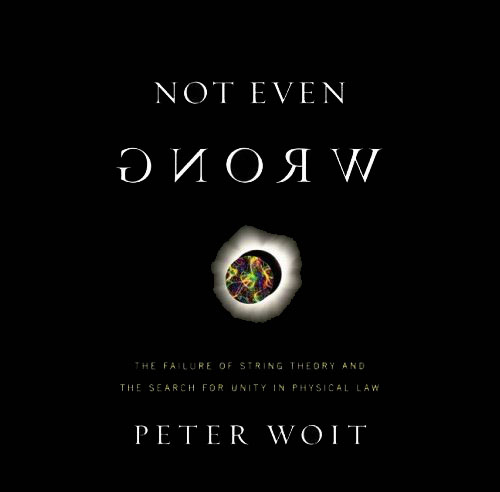
Not Even Wrong, by Dr. Peter Woit

One of our great laments is that science writers tend to be unable to properly convey scientific ideas to a lay audience. Some of this can be blamed on a liberal arts education based in the historic Greek emphasis on competence in the trivium (language) and quadrivium (science and music). In modern practice this divides the educational tracks of students, generally producing persons better at one than the other. As our system moves education into a very specific concentration in graduate school, these differences become more pronounced. Writers, the people who are trained to explain concepts via the written word, often have little knowledge of science and scientists often have little training in the use of language. This division greatly influences our view of Not Even Wrong, whereas other reviewers have focused mainly on scientific arguments.

At the outset we are in complete agreement with Dr. Peter Woit, lecturer in Mathematics at Columbia University and author of Not Even Wrong: The Failure of String Theory & The Continuing Challenge to Unify the laws Of Physics. As educated laymen in physics, we feel there is something at the least fishy about string theory. Not Even Wrong could go a long way towards explaining the failures of string theory for the general public and physicists if it did not try to simultaneously satisfy both.

Not Even Wrong is at least terribly confusing to readers with only a basic education in physics. While the argument presented in the book is, to our eyes, internally logically sound, it is very difficult to discern because of Woit’s insistence on writing for a diverse audience and his often confusing writing style. Dr. Woit is attempting to reach his colleagues in mathematics and physics whilst simultaneously disabusing the general, interested reader of misconceptions given to her by popularizing physicists over the course of the last twenty years. We do not believe he accomplishes the latter, and are unsure if the message of his book has effectively reached the former.
wrong
Continue reading

The Springtober Issue is Here!

Back when Axes & Alleys first premiered in 1903 the Internet was made of wood and powered by kerosene. Downloading an issue involved a team of mules and a mimeograph machine.

Thanks to the wonders of technology, you now only need a single mule. So, hitch her up and check out the latest issue of of the world’s greatest tractor related publication.

To download a PDF of the newest issue, just click here.

A Trip to the Museum with Dirk Benedict

dirk

It was a an early day and though a haze seemed to break the sunlight into a thousand intimate shards, a glow of beauty hung about the city as Dirk Benedict and I strolled along the edge of Central Park. Smiling gently, as he often does, he pricked an already yellowing leaf from a nearby tree. Instantly he identified it to me as a North American white oak, of the species Quercus alba.

Continuing our saunter in the direction of the museum, he spoke a bit on the subject of forestry and of conservation. Never one to preach or even cajole, Dirk Benedict instead told me of the beauty of Montana and as his words melted into the sweetest of poetry, I thought I saw half a tear form in the corner of his eye. Not a tear of sadness, but a simple illustration of how moved by beauty Dirk Benedict can be.

Tossing the leaf aside in his robustly casual manner, he began to sing a lovely song of the Old Country and we picked up our pace and bounded up the steps of the Metropolitan Museum of Art. With his Diner’s Club card in hand, he of course offered to pay for my entrance fee, but I declined his ever-present chivalry, though he did smile and assist me as I struggled to clip the little orange pin to my lapel. We made our way right, toward the Egypt section. It’s been said that Egypt is the gift of the Nile. Well, I must add my own comment that enjoyment is the gift of Dirk Benedict’s company.

As we strode down each hall, he would point to various works of art and make their beauty and history come alive in his eloquence. Mere oils on canvas became living legends as Dirk Benedict explained their significance. His words brought alive the torture and pain of each artist’s soul. In the hall of armor, Dirk eyed each suit of glistening metal intently, as if he could look into the past and see the glory and pageantry of ages long gone. Breaking the rules, as independent spirits oft do, he patted one of the suits of armor, closed his eyes delicately and almost beneath a whisper, released the ancient soul to Valhalla.

Before we left, he made certain to pause by a portrait of George Washington, and as Dirk Benedict’s eyes met the portrait, he inhaled defiantly and then invoked the painting, with a simple wish that our nation never fail to live up to the standards and dreams of the Father of Our Country. For a moment, I turned, lest I interrupt this private tête-à-tête. But before I could even look away, Dirk came springing up behind me with a playful twinkle in his eye.
You see, Dirk Benedict had an idea and I couldn’t help but go along with him.

Leaving the museum he paused by the door to recycle our pins and then out into the sunlight we went, where, from a vendor’s cart, he procured a couple of ice cream sandwiches and we enjoyed their cool, creamy deliciousness all the way back to the train.