
Croatian Airlines
Reply


During this month in history:
2005 AD: After one hundred years, Jules Verne continues to remain dead.
2004 AD: After purchasing a piece of the True Cross online, Ron Stanley of Kenosha, WI, wonders why the Romans made crosses out of plastic.
1988 AD: Brian Warner of Fort Lauderdale, FL, decides to try on some of his mother’s lipstick. He is disgusted to find out later that lipstick often contains fish scales.
1980 AD: Members of the band KISS are convicted of treason for selling nuclear secrets to the Iranians.
1954 AD: Adlai Stevenson invents the game of Beer Pong, also known as Beirut.
1944 AD: Nazi Fuehrer Adolph Hitler enjoys an apricot.
1889 AD: While attempting to design a revolutionary new kite, Alexander Graham Bell accidentally invents the telephone again.
1681 AD: Edward Teach grows a beard.
1602 AD: William Shakespeare scratches a dirty sonnet into a lavatory wall.
1578 AD: Samurai warrior Akakawa shames rival Tokogura with a beautiful and exquisitely composed haiku about how good crabmeat tastes.
1537 AD: Shortly before Spaniards arrive there, the Island of California joins the rest of North America.
1381 AD: Janth throws herself beneath the wheels of the advancing Juggernaut and has little to no effect on its progress.
1215 AD: At Runnymede, English King John first attempts to sign the name “Tohn” and then “Dohn” before the nobles make him write his real name on The Magna Carta.
923 AD: A Tatar named Multigin gets very angry when he stubs his toe. He raids a neighboring village, slaughtering the entire population and takes their herd of goats. This makes him feel better.
701 AD: In order to impress a beautiful, dark haired and blue eyed young girl with ample bosoms, Erthik begins writing the Beowulf Saga.
575 AD: Five year old Muhammad begins a life-long fascination with raisins.
483 AD: No one notices that the Nestorian Church has had a schism with the Orthodox Church.
102 AD: Pan Chau’s expeditionary force reaches the Caspian Sea. He sends reports home stating that there isn’t anything interesting out that way.
25 AD: An irate man in strange clothes, speaking in an unknown language attempts to stop several soldiers as they crucify a Jewish man. He fails to stop them due to a crippling and fatal bout of dysentery .
17 BC: Japeth of Judea thinks he could use a new smock.
274 BC: Rendithes of Corinth pens the most beautiful poem ever written. A visitor from nearby Porlock knocks over an olive oil lamp, causing a fire which burns down Rendithes’ house with all its contents.
440 BC: After wandering the entire Mediterranean, Herodotus remembers where he left his change purse.
765 BC: Ancestors of the Ainu people of Japan amuse themselves by using a wooden board with a snow monkey tied loosely on top to plug up geyser holes, then watch the resulting expressions on the monkeys’ faces when the geyser erupts.
901 BC: Cruthoatlec drags a valuable load of jade to his home across the isthmus of Panama, creating the first and short-lived Panama Canal.
1300 BC: A Phoenician named Dehrem steps on a sea snail and has an idea.
3,809 BC: A trader, who by pure coincidence is named Seanconnery, invents cuneiform.
12,003 BC: Shurprizh, a resident of Southwest Asia, produces the first play in history. It is remarkably similar to an unaired episode slated for the second season of My Mother the Car.
109,800 BC: After dropping a goose egg on a rock near the fire, Omak eats it, finding that the heat has transformed the egg into a congealed, rubbery substance. He spits it out and goes to look for some berries.
507,032 BC: A human band wins its third consecutive war against a nearby group of chimpanzees, thanks mostly to Churdu’s excellent rock-hurling prowess.
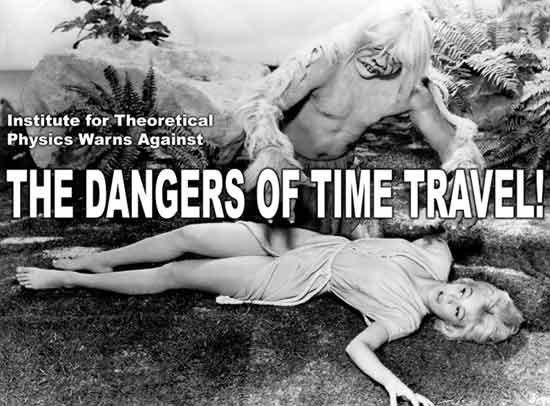
Time travel is not, and may never be, possible. However, a committee at the prestigious Flagstaff Institute of Theoretical Physics has released a new report detailing just how stupidly dangerous travel to the past or future may be. The report is of special concern to our growing corps of chrononauts.
“If you go back in time,” stated Dr. Steven Hawkins at a press conference held in the Luau Room of the Particle Physics Research Institute and Brothel “you may affect causality in numerous ways; say by killing your parents before they screw you into existence, or rolling your ATV over the sherwlike creatures which gave rise to all modern-day mammals.”
However, Dr. Hawkins warns against an even greater threat. “The real danger isn’t from paradoxes. It’s from disease.”
The group warned that the past is rife with all manner of pestilence, disease, and infections including, but not limited to, every disease ever. The FITP committee hypothesizes that a time traveler venturing, for instance, to 25 AD to prevent the Crucifixion would perhaps succumb to amoebic dysentery within two days before he could prevent the salvation of mankind.
“It wouldn’t be a pretty death either,” stated Hawkins. “Even the 19th and early 20th Centuries aren’t safe. We advise not venturing back more than a couple of decades if time travel is ever invented. Which it won’t be, because it’s not possible.”
According to a high-level official at NACTA, the National American Chronambulatory Travel Administration, the report is of grave concern to the nation’s fourth largest department. Both the Armstrong Administration and NACTA refused to comment for this article.
So, while it may be interesting to see what Napoleon could have done with machine guns and a logistics planning computer, any chrononaut who heads to Austerlitz with a crate Kalashnikovs and a planeload of MREs is going to be too distracted by small pox, diphtheria or cholera to enjoy the battle. Furthermore, photographs of Napoleon with a mustache could be taken, which would demoralize modern-day Corsicans.
The future may be safe, though people in the future will probably imprison and quarantine you before you even have time to look up your great, great grandchildren in some sort of futuristic phone book. You’d actually be quite easy for a group of futuristic, leopard-human hybrids to capture and we imagine they will take many photographs of you with their prosthetic audio-visual communication hands.
“If you have to go back, say to prevent Buddhism or something,” Hawkins concludes “it would be best to wear a containment suit that you burn as soon as you return to the present. Of course, you won’t ever do that, because time travel isn’t possible.”

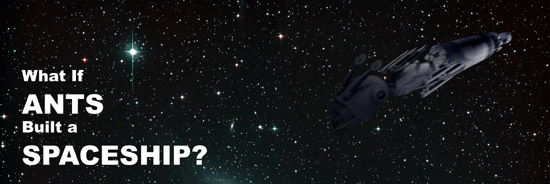
If ants built space ships most people assume they wouldn’t be very big because ants are quite small. Formic spaceships wouldn’t be as tiny as many assume, though, because ant colonies can get to be pretty large, covering acres of land to depths of several feet. Still, a spaceship built by a colony of ants wouldn’t be terribly huge.
The traditional image of ants created through science media is usually one of strife involving raids, slavery, and death. What if the space race brought the colonies together? I like to imagine that a space program would bring the entire race of ants together in a type of social insect utopia. In that case they would need a bigger ship.
A natural design for such a ship would be the shape of an ant itself, stylized of course to avoid infringing on the sensibilities of any species. From antennae to the end of the abdomen it would measure perhaps 12.7 kilometers long. The widest diameter of the ship would be across the abdomen, at around 6.1 kilometers.
The internal superstructure of the abdomen, legs, thorax, and head are to consist of enclosures which can be adjusted to the direction of thrust, providing a simulation of gravity. When the ship is in free-fall, the carpeted hallways will provide gripping points for the ants.
Propulsion comes through a hydrogen-fueled Bussard ramjet. The long, protruding antennae of the ship and the mandibles located at the front of the head are to produce the field for the craft’s ramjet. Interstellar hydrogen is to be guided through the mandibles and into the mouth, through the central fusion mass conduit modeled on an ant’s gut, and finally into the six fusion propulsion systems located at the tip of each of the leg structures. The fusion system will then provide thrust and power for the ship.
Biomass for the ants’ consumption would be located throughout the abdomen. Special fungus and aphid farms will be installed towards the front of this section for those species who require them. Otherwise the storage facilities will contain vegetable matter.
The thorax of the ship would contain gigantic environmental systems to handle the air and water needs of the ant colonies. The air processors will use oxygen and nitrogen generated by the biomass in the abdomen to supply the vast majority of atmosphere for the rest of the ship, while secondary storage and generation equipment remains on permanent stand-by in case of emergency. Since ants get most of their water from food, the water reclamation system required is much simpler as it is mostly there for the benefit of the biomass.
The filtration and recycling system is to be connected to the biomass storage facility through an open circulation system, constantly cycling water from the abdomen to the processing equipment and back. Connected to the fusion power plant at the rear of the abdomen through a set of tracheae, electrical distribution can be efficiently routed throughout the ship without sacrificing living or storage space. It can then be used as a secondary source for heating due to its proximity to the heating system.
The heating system will rely both on electricity coming from the fusion plant and the warmth from the moist, hot air created by the decomposition of vegetable matter in the fungus farms. After reaching the distribution junction, this air is then passed through the environmental system to extract its moisture, whence it passes to all points beyond.
Living space for the individual colonies will be located in the remaining areas of the abdomen. The fore section of the abdomen will feature environments dedicated mainly to those species residing in tropical and desert biomes, as these decks are closest to the heat distribution system. The top-most section will contain species from dry temperate locations, while the aft decks will contain species from wet temperate locations and those from cold or sub-arctic regions. Colonies residing near the engineering centers of the thorax will be those from environmental regions representing an extreme mix of temperatures and moistures.
The ship’s head is, naturally, to be the command and control centre. The lower portion will ensconce the main computer and auxiliary control systems (such as the Bussard field adjustment computer and environmental control). The upper portion, complete with multi-faceted view screens and other sensors built into the eyes, is the Bridge, which will be staffed by specially grown controller and navigator drones.
Astrogation and propulsion would be controlled directly from the Bridge. At the same time, command officer drones can issue orders to their various colonies through pheromone disseminating pneumatic tubes specific to each species. The pneumatic system carries a control pheromone to the appropriate colony located in the abdomen. From there a pheromone disbursement officer carries the message throughout the colony.
Colony Queens would spend the majority of their time at the Queen’s Deck, located in the bottom aft section of the abdomen, directly above the main docking bay. Most eggs will be kept in the temperature controlled storage decks, while some will be carried directly to the docking bay for placement on the landing pods used for colonizing suitable planets. The single airlock located in the extreme aft section allows for launching colonization pods, as well as for the jettisoning of trash and waste.
As you can see, a multi-species advanced interstellar craft for ants is a feasible idea for the most part. There are some problems surrounding ant cognition, manufacturing methods, and economic systems, but these can be overcome in time. Remember that Mankind took only six decades to advance from flight to space travel, and that ants have already been flying for millions of years.
After coming along with me on this beautiful journey into the possible, don’t you also think it would be wonderful for ants to reach for the stars, come together in filial admiration, and build a fancy, ant-shaped spaceship? I thought you would.