A Guide to Monkeys
Reply

WANTED
Spelunking helmet for medium sized dog. Trevor Malady, 718 Box Street, Pavilion, NH.
FOR SALE
The thing to make all your theories work. Whatever it is, I’ve got it. Need an Earth-sized object in the outer solar system? I’m your man. Aliens in pre-Columbian America? In stock. The remains of big foot? First glass case on the left. Jimmy’s Theoretical Keystones, Katharinetowne, WD.
WANTED
Female Michael Ansara impersonator. Must be able to impersonate Mr. Ansara as Cochise from Broken Arrow, Kang from Star Trek “TOS” and Mohammed from The Message (bikini only). $25/hour. Free punch included. Cookies if available. Alexandra Politchenko, PSU Hall #5, Pylon, PL.
FOR RENT
Toe nails. Several shapes, sizes and colors. 50 cents per day per nail or $75 per year (in advance). Louisa May Alcott, 314-998-1616.
FOR SALE
Large box of punctuation. Includes commas, apostrophes and several semi-colons. No periods. •2.00. Minnie Ghent, Box 421, Grossover CEDEX 7, France.
FREE
Two lovable kittens, one black and white the other tabby. Both short haired and around seven weeks old. Free to a good home. Some assembly required. Yasper Yeats, Talladega, AL.
FOR SALE
One spoon, convex style digging or eating implement. $.02. Yasper, Box 45.
POSITION AVAILABLE
Tire iron, jack and spare tire needed to sit in my car trunk in case of emergency. No pay or time off provided. Sally Macgregor, Attenborough, Scotland. Ring top bell.
FOR LEASE
Seventeen story barn in Financial District. Zoning regulations forbid use by livestock. Spacious haylofts and two elevators for grain. Red in color with “See Rock City” painted on roof. Turing Realty, New York, NY.
WANTED
Series of seven bibs featuring paintings by Titian. I have seven children who need bibs and I’m just delighted by the idea of them making a mess of Titian’s paintings because I hate Titian. Ragard Moore, 748-282-2811, ext. 283. Mention this ad to sell me the bibs.
FOR SALE
Fungus-shaped thermite charges, 30 per box. Realistic spore dispersing action included. Great for fooling and then destroying fungus. Only $65! Rory Macklebik 93 Worcester St., Poughkeepsie, NY 12197
WANTED
A normal German to be my friend. By normal I don’t mean the average German who enjoys necrophiliac movies and does odd things with spandex. I mean a normal German as in an American who can speak with a pretty good Bavarian accent. Call Lucy Spangles at 707-823-7554.
FOR SALE
Impounded lorry full of soiled restaurant clothing. Free 36 ml tube of Veruca Salt vulcanising fluid included. Tony Blair, 10 Downing Street, London SW1.
FOR FREE
Giant chicken wire and plaster of paris Buddha statue I made three years ago. It’s pretty darn big. Drooping a bit near Gautama’s buttocks. We’d like some more sun now, so it’s free to anyone who can come get it out of my backyard. Parking for cranes available. Call Joseph Mascis at 202-414-3113.
WANTED
A solution providing orgasms for paramecia. Write to the International Paramecia Operating Group for Orgasms, The Hague, The Netherlands with your proposal.
FOR RENT
Buttery cashew brittle! $2/day. Mrs. Fanny Bukowski, Apartment 3, Roanoke, VA.
FOR SALE
A mellotron. My son said he had always wanted to play the mellotron, but when it arrived it turned out he had meant the wash tub. $3500. Like new. James Thomas Carbunkle IV, West Nickel Lane, Burlington, VT, Sinonipponesia.
FREE
Do you love thinking? Do you often have ideas about God, the place of man in the universe, or the ethics of pudding production? Then you might be a philosophiliac! Come on down for a free examination to find out if you’re a lover of thinking. Remington Philosophiliac Institute, 2401 I-35 Frontage Rd., Oklahoma City, OK 73160
WANTED
Participants needed for a medical study of users of social networking web sites and gullibility. Visit N 33° 39′ 39″ W 95° 33′ 19″.
Tuesdays are usually an off day for those of us in the Axes & Alleys online management department. But, we’d like to point out the amazing success of our second video, Conversations with Fiona Apple. In the last three weeks, it has been viewed over 4000 times. We’re not sure why, but let us encourage the trend.
We’ve got three new films in the works, so stay tuned.

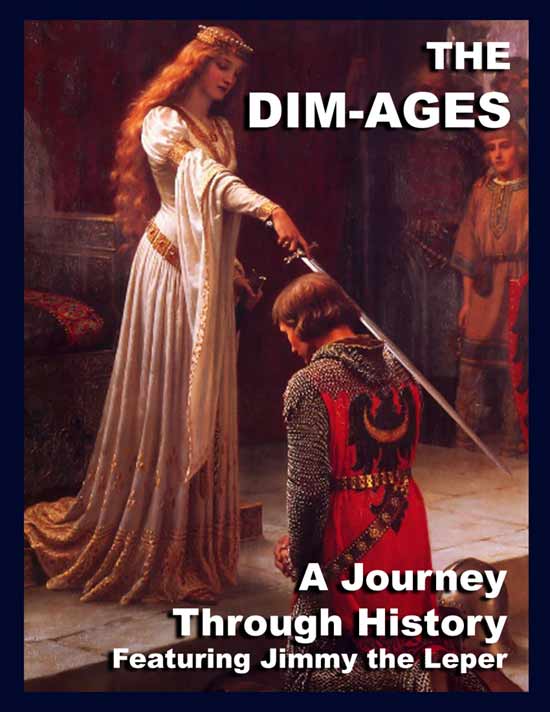
Children’s stories are chock full of knights, squires, castles with moats, and damsels who require a healthy amount of rescuing. Of course, these elements have about as much basis in historical fact as the wizards, witches and dragons that also populate the same stories. That is to say that there were real witches, real dragons, real knights and real castles, but the real ones have little in common with their romantic, faerie-tale counterparts.
This is the true story of the Dark Ages, as some call it. Yes, there was a period of time from 500—1000 AD, but what we’ve been told about it is based in 19th Century Romanticism, Roman propaganda and other fictional generalizations. The Dark Ages, while certainly dark, weren’t any less well-lit than any other period in history. No matter what was going on, the lives of the vast majority of people didn’t change a bit, despite the varying empires and cultures which rose and fell. For Jimmy, the peasant with leprosy and his fellow diseased, poverty-ridden ilk, it didn’t matter if you had a consul, an emperor or a lord oppressing you. You were still being oppressed.
The schoolmarm’s old yarn is that the Roman Empire, grand as it were, collapsed and that Barbarism spread throughout Europe. Knowledge was lost, learning stopped, and poverty and superstition reigned for a thousand years until some enterprising artists decided to start painting with perspective and to make really big versions of Greek
statuary. Here we hit the Renaissance and have a happy ending for Jimmy the Leper. As always, the truth is just a bit more complicated.
First there’s one major fallacy to dispel: the classical glory and grandeur of the intellectual paradise of Greece and Rome. Despite what Mrs. Rowland taught you in middle school, the Roman Empire was full of squalor, filth, disease and hunger. In the Greco-Roman world, as in the Dark Ages, practically everyone lived in filth and poverty. Which is better: the cramped, dark tenement or the cramped, dark hovel?
They were poor people, they were diseased and they were oppressed by people who, while not being particularly healthier or cleaner, were certainly richer. If you want to know how truly grand life was in Rome, don’t ask Pliny the Elder, ask Jimmus the Galley Slave.
To put this in perspective, let’s say you put all the people who ever existed into a large bag and pull out a million at a time. Your chances of retrieving one rich, healthy and clean person are about the same as those of procuring a bag large enough to hold every person who ever existed.
The Greeks’ main claims to fame, though, are their culture, learning and art. Well, not all of the Greeks. Only a handful excelled at this and for the most part they weren’t highly paid or not killed. Some weren’t both (look up Socrates some time). They did invent geometry. But then they made it a religion and refused to allow any practical applications of geometry. You know, it would cheapen rectangles and whatnot if everyone knew about them. Some people were so upset with the Pythagoreans for hiding the wonders of the perfect solids that they lynched them upon discovering these great truths were being kept from them. How enlightened.
Also, they invented democracy. Well, they invented something sort of like democracy. That is to say they invented something close enough to democracy that we took their name and used it to describe the idealized version of our current system. No slaves, women, or people busy finding food, please.
The people who made up the bulk of the population? They didn’t care. Rectangles, perfect forms and democracy didn’t help get the dung smell out of a tunic. And you were in real trouble if you lived near the city’s sewage system, if your city was lucky enough to have one. Nope Jimexanos the Leper didn’t get an iota of relief from The Republic. It’s ever so slightly difficult for your people to appreciate your culture’s great literary works when the vast majority of your people are illiterate wretches.
The Romans, however, were the real masters of culture and learning, which they mastered by ripping off other people’s ideas. The Romans’ ideas were “adopted” from the Greeks, Phoenicians Carthaginians, and Etruscans. The Romans were famous for their roads, many of which they found intact after the Persians had forgotten to take
them when they left. Those famous Roman roads were a great benefit to the common people, who were able to utilize them as they were forcemarched in chains down the roads so that they could be whipped as they built the next section of road.
No, the truly unique cultural achievement of the Romans was murder. They loved murder; it was their favorite. While the slaves and Plebeians watched other slaves and Plebeians being murdered in the Coliseum, the Patricians were busy murdering each other to see who could win the right to be the next consul or emperor to get murdered.
Eventually the so-called Barbarians got into the game by murdering lots of Romans and the Empire collapsed. All the while, Jimmus the Galley Slave was still a leper living in filth who got to see an occasional sculpture and mighty temple on those few occasions when his galley would dock. But, in the end he was still a leper and a slave.
And then around 500 AD the Dark Ages began. Actually, it was 476, but it’s easier to just round up. So, the crux of the issue is this question: did the collapse of the Roman Empire cause regular folk roundabout Northern Europe any more problems than they already had?
Northern Europe hadn’t quite benefited from all this prosperity, enrichment and enlightening. Actually, it kept on doing its dirt-strewn, illiterate best throughout the
existence of Rome. It was cold, heavily forested and inhabited by bloodthirsty drunks. We call these people Celts. There were also some Goths involved who
eventually founded Austria. Good for them. No matter what was going on or which empire happened to be in ascendancy at the time, they remained bloodthirsty,
drunken farmers. Occasionally one of their leaders got the bright idea to ravage those enlightened softies to the South. You see, the real benefit bestowed upon Northern Europe by the Roman Empire was centuries of warfare and enslavement. The collapse of Rome actually improved these peoples’ lives slightly, as it meant they
could go south and bring more loot back home.
A good example of how the collapse of the Roman Empire affected Northern Europe might be the city of Aachen. From Neolithic times up to the era of Greece and Rome it was a minor, backwoods village where farming and stone quarrying happened. Then, a few centuries after Rome fell, Aachen became the capital of a large empire, home to massive palaces and cathedrals and, under Charlemagne, a center of learning and culture.
It doesn’t exactly seem to follow that the collapse of Rome caused a Dark Age in Aachen, especially since the so-called Dark Age turned it from a stone pit to a powerful cultural and political center.
The supposedly backwards people of Northern Europe in the Dark Ages turned out to be fairly skilled engineers and structural designers. During a period devoid of learning, they managed to go from building wooden forts called mot and baileys, to building huge walled cities, massive castles and ridiculously intricate and enormous cathedrals. Granted, they didn’t have 100,000 seat capacity coliseums, but they certainly knew how to stack their stones. Of course the person stacking the stones would have been Jimmy the Peasant, who besides having no rights or money, also had to grow food for everyone, give up a few months out of the year to be trampled by knights in battle and spend another few months hauling stones to build those mighty cathedrals. He probably had leprosy, too.
Speaking of cathedrals, the Dark Ages were known for theocracy and superstition. Though it’s not exactly fair to single them out in that respect. After all, the Romans believed in a pantheon of fickle gods (ooh, Janus god of doorways!) and the Pythagoreans actually believed that dodecahedrons were sacred (though they didn’t give a fig about parallelograms). Of course the Renaissance and “Age of Reason” mark the end of all this. Europe spent those couple of centuries celebrating Reason by fighting religious wars, burning suspected witches, and lynching smart guys.
As you can see, Jimmus, Jimexanos and Jimmy weren’t doing too well regardless of what period in history they lived or which culture happened to be waxing or waning. Whether they were forced to build a Parthenon, an aqueduct or a castle, they were still whipped if they didn’t go fast enough. Whether they were being marched off to war against the Persians, the Parthians or the Muslims, they were still put out in front and armed with farm equipment. Whether their home was Athens, Rome or Aachen, they were still living in filth, disease and squalor.
None of this though, should be taken as an attempt to defend the Dark Ages as a wonderful period in human history. The point is that the Europe your teachers taught you about during the Dark Ages was rife with disease, poverty, oppression and superstition, just like every other time period for which we have records. Remember that the next time you see a story about the Middle Ages. Also, remember that everything your teacher told you was wrong. You don’t listen to that woman, you listen to me.