
Why Mormonism is Not the Least Bit Like Blink-182. At All.
Professors Robert Burg and Dr. David Louzecky of the University of Wisconsin, Sheboygan, published a paper in this month’s History entitled “Enema of the State of Utah” in which they purport to lay bare the deep connections between The Church of Jesus Christ of Latter Day Saints and the now-defunct pop-punk band Blink-182. This preposterous position is indefensible and ridiculous.
In their introduction, the “professors” state that “the connections between the Restoration movement in 19th Century America and the late-90s emergence of the pop-punk phenomenon are obvious.” If any such connections were so obvious Dr. Louzecky (who obviously penned this scabrous portion of the paper), why didn’t anyone point this out earlier?
They go on to outline the various groups struggling for existence during the Restoration and compare this state of affairs with that record labels faced in the 1990s in attempting to “increase sales by meeting the perceived or manufactured demand for pop-punk music by offering up dozens of such instrumental groups to consumers.”
One might as well compare any group of things struggling for supremacy to any other. If we’re to play so loose with logic, the pop-punk era also bears a striking, whiz bang similarity American politics immediately preceding the Civil War, the struggle for control of the Muslim world in the 7th Century, and the Warring States period of Chinese history. In that case MxPx must be pretty damn similar to the Wei, right? Wrong.
In order to bolster these specious claims, Burg and Louzecky point out that Blink-182 and Mormonism were the “sole major successes of either movement.” This is patently false. Mormonism is only arguably a member of the Restoration movement as its initial history involves little time spent in the influential East of the United States and the promulgation of a completely new testament, something virtually unheard of amongst other Restoration congregations.
By contrast, Blink-182 was almost immediately at the forefront of the pop-punk in the late-90s, inciting the release of other acts such as Good Charlotte and Sum 41, but followed in the footsteps of groundbreakers Green Day and The Offspring. Some would even produce lacklustre punk pioneers The Ramones at starting end of pop-punk history.
In response to a referee’s critique similar to this one, Professor Burg points out that Mormonism also had hangers on in the form of the Churches of Christ and the Disciples of Christ as well as antecedents in the Anabaptists. This immediately disproves the previous point as both churches exist today with memberships near three million worldwide. While the Anabaptists no longer exist, neither do The Ramones. I’m still outraged that such sloppy research and thinking made its way through the initial review process of a major publication.
Taking this preposterousness further, the good “professors” compare the physical appearance of Blink-182 drummer Travis Barker to that of Latter Day Saint second-stringer Brigham Young. Take a look for yourself.
Professors Robert Burg and Dr. David Louzecky of the University of Wisconsin, Sheboygan, published a paper in this month’s History entitled “Enema of the State of Utah” in which they purport to lay bare the deep connections between The Church of Jesus Christ of Latter Day Saints and the now-defunct pop-punk band Blink-182. This preposterous position is indefensible and ridiculous.
In their introduction, the “professors” state that “the connections between the Restoration movement in 19th Century America and the late-90s emergence of the pop-punk phenomenon are obvious.” If any such connections were so obvious Dr. Louzecky (who obviously penned this scabrous portion of the paper), why didn’t anyone point this out earlier?
They go on to outline the various groups struggling for existence during the Restoration and compare this state of affairs with that record labels faced in the 1990s in attempting to “increase sales by meeting the perceived or manufactured demand for pop-punk music by offering up dozens of such instrumental groups to consumers.”
One might as well compare any group of things struggling for supremacy to any other. If we’re to play so loose with logic, the pop-punk era also bears a striking, whiz bang similarity American politics immediately preceding the Civil War, the struggle for control of the Muslim world in the 7th Century, and the Warring States period of Chinese history. In that case MxPx must be pretty damn similar to the Wei, right? Wrong.
In order to bolster these specious claims, Burg and Louzecky point out that Blink-182 and Mormonism were the “sole major successes of either movement.” This is patently false. Mormonism is only arguably a member of the Restoration movement as its initial history involves little time spent in the influential East of the United States and the promulgation of a completely new testament, something virtually unheard of amongst other Restoration congregations.
By contrast, Blink-182 was almost immediately at the forefront of the pop-punk in the late-90s, inciting the release of other acts such as Good Charlotte and Sum 41, but followed in the footsteps of groundbreakers Green Day and The Offspring. Some would even produce lacklustre punk pioneers The Ramones at starting end of pop-punk history.
In response to a referee’s critique similar to this one, Professor Burg points out that Mormonism also had hangers on in the form of the Churches of Christ and the Disciples of Christ as well as antecedents in the Anabaptists. This immediately disproves the previous point as both churches exist today with memberships near three million worldwide. While the Anabaptists no longer exist, neither do The Ramones. I’m still outraged that such sloppy research and thinking made its way through the initial review process of a major publication.
Taking this preposterousness further, the good “professors” compare the physical appearance of Blink-182 drummer Travis Barker to that of Latter Day Saint second-stringer Brigham Young. Take a look for yourself.
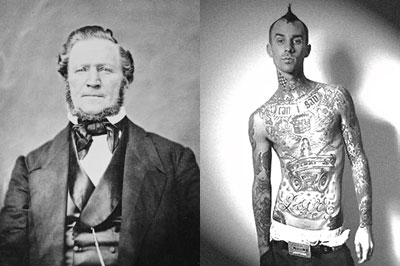
Clearly they’re both unattractive, though with a quite-surprising glint of intelligence in their eyes. However, the similarity ends there. For instance, Brigham Young wears clothes. Travis Barker can’t even be bothered to wear a belt.
Of course, the pair have left their most disgusting and mendacious pronouncement buried in an unassuming paragraph at the end of the paper on production values and land acquisition inspired by God. It is well-known that one of the tenets of the Latter Day Saints was the revelation of the Book of Mormon to Joseph Smith by the Angel Moroni.
In what is clearly a fiction created by Burg, it is unconvincingly shown that the angel and Enema of the State producer Jerry Finn share “remarkable and definite similarities.” These similarities include the fact that Moroni was a “record producer” because he came up with golden tablets inscribed with writing. How far can you stretch the truth, really?
You can find out by reading “Enema of the State of Utah,” which has already and unfortunately sparked discussion nationwide. Water cooler talk, local television news broadcasts, even editorials in free, weekly rags are expounding on the paper. One would hope such discussion casts a cold eye on the claims of Burg and Louzecky. Even the motivations of the two men are suspect, as I leave you with this statement from a KKBC-Kalisotta Public Radio interview with Louzecky.
“Hopefully the paper’s publication will bring in some big donors so we can get one of those nice, self-serve pop fountains in the Café.”
By Art Gomez, Associate Professor of Paramycology at the Pendergast Institute. Mr. Gomez is Chairman of the U.S. Thinking Committee, Vice-Admiral of the Civilian Naval Corps and a member of the American Historical Association. While born under the sign of Aries, he does not believe in or espouse astrology of any kind.