A Histronomy Essay

The Story of the Modern
Steam-Powered Tractor

Dr. Scott Birdseye is Vice-Treasurer of the
Royal Tractor Repair and Maintenance Society
of Belgio-Luxemburg. He was recently awarded
the Nobel Prize in Nanolinguistics.

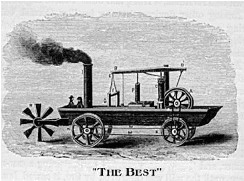
Among the AgroFarm™ Museum’s historic collections is Daniel Bester, Inc.’s Daniel Bester steam traction engine. At the time the steam traction engine was devised, Daniel Bester, Inc. was known as Bester Technologic & Farm Implements, Ltd.

The Daniel Bester Steam Traction Co. was the first subsidiary of the company (later to become AgroFarm™ in 1967), which was spun off in 1962 to latch onto what company insiders believed was a resurgent technology, steam power.

The steam traction engine was originally used by the Kalisotta Mining Consortium to haul protesters from the nascent eco-terrorist movement off the premises of KMC mines and logging interests. KMC, now a Daniel Bester, Inc. subsidiary, placed an initial order for 20 of the machines.

The steam traction engine boasted impressive specifications for such a device. Rated at 110 horsepower, the machine masses 19 tons, stands 18’8” inches tall, has side-by-side operations stations and nodes for 16 different attachments.

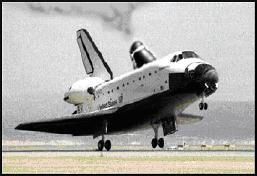
Unfortunately, the erroneous assumption that steam power was on its way back sidelined the project, subsequently forcing other steam power contracts to be cancelled. In addition to the approximately 2000 orders placed for the steam traction engine (no doubt pushed by Bester Technologic & Farm Implements, Ltd. lobbyists and salesmen), plans were going forward with the U.S. Navy for a prototype CVE (escort carrier) model and steam bullet trains for the Elizabethia metroplex. Talks with NASA for contracts in steam powered space exploration were also cancelled.

The last surviving model of the “Best” was given to the historic collections in 1983, and restored by renowned farm implement specialist Moriarty Jones. Today, the Daniel Bester, Inc. steam traction engine is housed at the Daniel Bester, Inc. Historic Collections Farm Mockup in Katharinetowne, West Dakota.

A dedicated group of historic collections recruits and Daniel Bester, Inc. Community Service Crews maintain and operate the Daniel Bester, Inc. steam traction engine. The public is invited to see this magnificent machine in operation on several days during the year.

The steam tractor is scheduled to be fired up on alternate Wednesdays in June, every other Thursday in July and sunny days in August. The Daniel Bester, Inc. Historic Collections can be contacted by showing up in person at 34 Bester Expanse Katharinetowne, WD between the hours of 9 AM and 1PM on Fridays.

News of the World: July 2005

Eight Persons Consumed
in Deadly Tractor Fire!

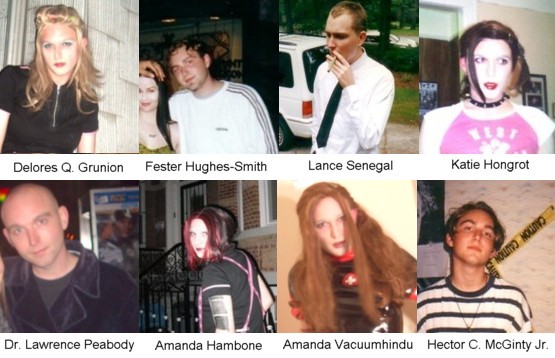
victims

Helmutsboro, WD– In what has become a startling trend across this great land, eight more lives were claimed Tuesday night by the Herkison “Semiglide Model V” Tractor-Mulcher. Although Imbecile Party Presidential Candidate and Self-Proclaimed “Product Safety Guru” Ralph Nader described the Semiglide Model V as “A fully dangerous piece of farming equipment which is unsafe at an measurable velocity,” the tractor remains popular amongst farmers due to its many spacious cup holders and its bucket seats, which can sit up to ten average sized adults.

Montsylvania College of Technology Design Arts Physics Professor Dr. Stephen Hocking claimed that Mr. Nader’s comments are unfounded as there is no way to measure both the velocity and position of the tractor simultaneously. “In fact,” added Hocking “the very act of measuring the tractor changes the very nature of the tractor, so there is no way to accurately measure it. Therefore, how does one ever determine a safe ‘measurable velocity’ of the Semiglide, or of any tractor or riding mulcher for that matter?”

Though Hocking’s defense of the tractor is scientifically accurate, this is of little consolation to the families of the Semiglide’s latest victims, the eight souls claimed Tuesday night when a Semiglide Model V belonging to Helmutsboro agriculturalist Tommy Thalmudge spontaneously burst into flames. Even though the victims attempted to escape, witnesses described that they died horrible, agonizing deaths in the flaming tractorous hell pit. The tendency of the Semiglide Model V to burst into flames without warning is attributed to the location of the main hydrogen bladder, which is directly adjacent to the tractor’s spark plug ignition mechanism. When the tractor’s engine is engaged, it is possible for rouge sparks from the ignition to contact the hydrogen bladder and cause spontaneous combustion, resulting in a massive fire which immediately consumes the tractor and all its unfortunate occupants.

In our exclusive interview, Mr. Nader questioned the very reasoning behind putting a hydrogen bladder on a tractor at all. “Why” he asks “Did the designers put a hydrogen bladder on a tractor? There is no reason to have it there at all, it doesn’t facilitate farming or tilling at all, in fact, the cumbersome bladder seems to get in the way of tilling actually. And, since hydrogen is highly flammable, it seems strange that the designers would include an unnecessary hazard that actually limited the capabilities of the machine. This is evidence of a very poor design.”

A spokesman for the Herkson Traction Company stated that while the company felt the pain of the victims’ families, the operating guide distributed with every tractor clearly states that there is a danger of combustion if the tractor is ever used for any reason. “These deaths are unfortunate” stated Herkson spokesman Tad Mailing “but to hold the company legally responsible for these deaths is absurd. The customers knew what they were doing, the danger is clearly stated in the owner’s manual, furthermore, not adhering to the manual not only voids the warranty, but also prohibits any legal action against the company.”

No matter who happens to be correct, it is a very sad day for Helmutsboro, and for all farmers and tractor fanciers everywhere.

A Specialized Poeticism

By Resident Fellow-Bout H.G. Peterson

H.G. Peterson is the inventor of the
Radio-toaster; a device which can toast
bread at a distance of 5.6 billion light
years. He enjoys nuclear-bingo and
poodle collecting.

An Ode to the Space-Men

From the stars you come in mighty craft
With ray-guns fore and rockets aft
Small green men in silver suits
With bright blue stars across your boots

To the Earth you come from outer space
Bringing knowledge to our inferior race
Your flying saucers descend like a vulture
Upon the sights of our agriculture

Though tractors you do not possess
Your work a tractor does suggest
For when in the morn we look up on the field
Our wheat shafts to your beams did yield

Designs you make into our crops
Circles in barley and squares in hops
Do you bring messages of peace
Or recipes for roasting geese?

Methinks there is another factor
You are just jealous of our tractors.

A Brief History of Tractors

By Rev. Jeremy Rosen

Rev. Jeremy Rosen is the Clem Pickford Scholar
in Residence for Tractor and Farm Implement History
at Montsylvania College for Agriculture Technical
Design Arts’ Astronomy Department. In his spare
time he enjoys bocce ball, studying ancient
soothsaying entrails sites to see if they were right
and balcony construction.

The first tractor was the mule or ox, whence the modern terms for an engine’s power, oxpower or the less popular horsepower. These early meat tractors replaced human power in agriculture. Mechanical creations built around fantastic dynamos eventually replaced the meat tractor as the ideal farming tool late in the 19th Century. The development of such mechanical creatures is the story of humanity and civilization.

Until around 1920, meat tractors were seen commonly in the company of steam or dynamo-powered tractoring contraptions. Steam engines were mounted on carriages and became self-propelled, prompting manufacturers of gasoline and dynamo powered tractors to do the same. With one brief resurgence in the 1960s, steam power has all but been replaced by internal combustion in the last century.

In 1891, contrary to establishment claims of a latter date, Edwin Pomeroy constructed the first tractor which could go backward. Subsequently, he built a tractor with left turn capability and a cup holder (the first recorded use of such a device). His Replacement Meat Tractor Service was later purchased by what we now know as AgroFarm™.

The Pomeroy and other such early marvels caused many farm accidents, even though they lacked speed and oxpower until the engines were improved. Many migrant farm workers were so entranced by these mechanical beasts that they stood stock still as the machines bore down upon them. As a proper break had not been invented yet, the drivers were unable to stop.

During World War I tractors became the initial basis for modern tank weaponry. The first true tank, the Abelson Mechanotillery Mk. V was built upon a Pomeroy frame. The Great War saw a lack of farm labour and increased demand for all agricultural products, due to the requisitions of the U.S. armed forces. The Age of the Tractor began.
In 1917, Luscious Delacroix, of the Delacroix Motorworks stepped in to meet the demand. Delacroix used the increased efficiency offered by Henry Ford’s assembly line system to manufacture Delax tractors cheaply, with the initial cost being $200 dollars or less. Delacroix, incidentally, also invented the idea of annual percentage rate financing (or APR) used by the modern automobile industry. The oft forgotten servitude clause of his tractor loans has been discarded by an increasingly liberal and skittish public.

The Delax was so named because Henry Ford had several high-placed spies in the Delacroix Motorworks who informed him of Delacroix’s intention to manufacture and sell tractors. So Ford hired a young man also named Delacroix and began manufacturing his tractors under that name. Only a few bogus Delacroix’s were ever built, however, because Ford soon pushed Delacroix out of business and renamed his company the Ford Motor Company.

In 1932, nearly three times the number of tractors produced in 1929 were used on farms across the U.S. Maizebelt. The Zelbit DRX-274/B.25 DD was introduced that year, bringing tractoring to new heights of glory. It introduced several features that were to become a trend on the tractor market.

The Zelbit DRX-274/B.25 had five wheels instead of four, included a spare wheel kit for long distance tractoring and was the first multi-purpose tractor. It’s distance tractoring capabilities allowed it to function in the field and on the road and the extra wheel allowed greater buoyancy for pleasure boating in nearby lakes.

This was wholly due to the Ford company’s introduction of rubber tires, which gave a smoother ride and more speed. Racing engine enthusiast Thomas “Sonny” Bonaventure took a Zelbit DRX-276/B.26 out during this great age and drove the rubber-tired tractor to an astounding 55MPH, thus setting the eventual speed limit on most national highways. Sonny even got a moving violation ticket on this adventure!
The 1940s saw the emergence of a new ethos in tractor design, luxury! Tractors took on streamlined appearances, sporting huge headlights for night driving, propellers for pleasure boating and cushioned seating for four. One idea was most prescient.

The Kalisotta-Bestoria Company, in 1938, thought to itself that a design should be implemented where not only could a farmer plow his fields, but take the family to the show, into town for an Italian dinner, or to even greater heights of tractordom. The result was the ComfyTract, complete with flashy hood ornament, headlights, an optional closed cab, dining compartment, compass and, with optional HEMI, a top speed of 47MPH.

New York ad firms maintained a nice run of publicity with the ComfyTract. Pictures of socialite couples in formalwear dismounting their ComfyTract in front of New York landmarks were not uncommon. Farmers didn’t buy it, however and thus the ComfyTract didn’t sell.

Though the initial tractor/tank hybrids were not entirely successful, the tractor manufacturers spent many years under contract to the U.S. armed forces of light and good. After the War for Ultimate Freedom, tractors were further upgraded again and again, some featuring fantastic new options, increased performance and usefulness. One tractor was even built on the chassis of an automobile!

AgroFarm™ was the first company to introduce electric dash lights and key-fired ignitions, forcing other companies to do the same to compete and making the upgrades come into general use. Ailerons and five point power traction (most notably on the Bester Technologic & Farm Implements, Ltd. SuperFarm Cab Tract around 1959) improved the versatility and performance of tractors everywhere. The introduction of transmissions using more than one gear, shift-on-the-go, nuclear power steering, and reclining seats relieved John Q. Farmer of the awkwardness, anxiety and discomfort of farming. Turbo-charged diesel engines began to replace their gas-powered predecessors, raising maximum oxpower to 150 and making the tractor race a popular national pastime.

The modern agriculture enabling nucleo-mechanical furrowing device, like the 1979 AgroFarm™ Technotract would be unrecognizable to Delacroix, the farmhand who died at such a machine’s hands or the farm owner who bought his Delax in the earlier part of last century.

In the unsurpassable comfort of an air-conditioned cab, listening to his stereo eight track, with optional cup holder and nuclear powered steering, the modern farmer might be found in his field opening 4 furrows at a time at speeds of nearly 6MPH. On the other hand, he might have to pay $575,000 for that comfort and ease-of-work. Humanity has come a long way from the days of the meat tractor and the future looks bright for all things tractorial!