The March of Progress: August 2004

Thomas Alva Edison and the New Electro-Ethereal Power
Edison

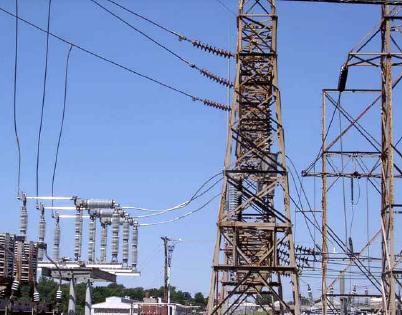
Great advances come to the Paris of the Pine Trees which promise to invigorate our bustling municipality. A few years ago the process of refitting and upwardly mobilating the gradient of lighting and power systems was begun by fellow members of the Pluto-Theosophy party. These have come to a fortuitous and American conclusionwith the ignition of our very own direct current power station, provided with the good graces of famed constructomaton Thomas Alva Edison.

It has been bandied about, with no lack of help from the craven Oligo-Unitarian Party, that alternating current, not direct current, is the proper and patriotic current. Such specious remarks are patently false, unabrigedly non-sacrosanctand perhaps incorrect. While alternating current, like the party which supports it, changes direction many hundreds of times a second, direct current efficiently and continuously (except during recharging) flows in one direction, directly into your own home!

One wouldn’t be desirous of a type of current which scores of times plied the ether in a direction not that of one’s fine Bethany’s lamps, would one? Whereas alternating current, like the Oligo-Unitarian party, requires miles and miles of wiring and urban sprawl to function, direct current satisfies one’s power needs with a fraction of the wiring and no such ungainly sprawl. Alternating current is the power of filthy immigrants. One can only imagine such generating stations powering and protecting growing Katharinetowne for true-born West Dakotans in the years to come!

A complicated system comprised of scary items; dynamos, mutable amalgams endowed by their decidedly European creator Tesla with the moniker “transformer,” the enigmatic a.c. motor; is clearly not the system for greater Katharinetowne! Clearly a system involving a simple battery is better. Batteries recall patriotic visions of our forefathers battling the scourging British and lobbing liberty shells from their batteries. Such is the American-accepted, American-invented system supported by the Pluto-Theosophy party; a system made by an American. Direct current is the American current.

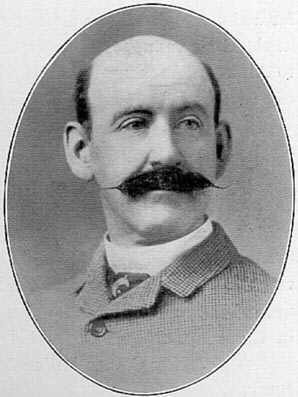
Jeremy Rosen

Jeremy-Joseph Rosen is the greater Katharinetowne City Council member for Ward 14 and Chairman of the Council Sub-Committee on Modern Powering Systems. In 1997, he won several prizes in the Grand Nationals of Underwater Floral Arrangement.

How to Do It: August 2004

With Regular Commentator LeMuel LeBratt

By Permanent Guest-Commentator Marcia Spatzelberg

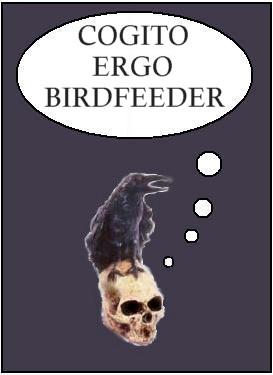
Greetings, boys and girls. This month’s fun project is going to be totally fun. I’m going to teach you how to make a bird feeder out of an important French Enlightenment figure.

Materials

  • One Rene Descartes’ skull
  • Two feet of aluminum wire
  • Two 3?4 inch washers
  • Two 3?4 inch wood screws
  • Two 3?4 inch wing nuts
  • One remains spatula

Step the First:
Use the handy remains spatula to clear away any three-hundred-year-old bits of rotted, decrepit flesh. Although it isn’t necessary, you may want to snazz up Mr. Descartes’ with some water-proof varnish or skull wax.

Step the Second:
Turn the skull upside down and use a handsaw (sorry, the handsaw should have been mentioned in the Materials section above) to remove the skull cap; the first two centimeters of the domed top of Mr. Descartes’ earthly remains.

Step the Third:
Use the other items to make a handle.

Step the Fourth:
Fill with birdseed and hang from a tree.

Step the Fifth:
Enjoy watching birds eat from one of the world’s greatest philosopher’s heads.

The World of Histronomy

With Dr. Scott G. Birdseye

Scott Birdseye is a professor at the world-renown Botham
University in Himmot, Accadia. Throughout his life he has
traveled to various countries, written various things and
seen up to seven different types of brickwork. He does not
enjoy mushrooms; both the flavor and the texture; in his
opinion, are entire unappetizing.

On the Subject of Forts and Fort-Like-Things

Just as weapons can be divided into two distinct classes: shock and missile, so can military tactics be divided into two different categories: the light, fast and maneuverable and the heavily armored yet. There are abundant examples in the history of warfare of instances wherein different categories of weapon or soldier were able to claim supremacy of the field, whether shock troops such as the Medieval knight, missile troops such as the longbow, or fast, light troops such as guerrilla fighters. Each specific attribute provides both strengths and weaknesses, as is the case with heavily armored yet slow troops, an example of the sacrifice of mobility for protection. The ultimate example of this sacrifice is the permanent fortification.

Completely lacking mobility, permanent fortifications, though their imposing strength could prove themselves nearly impossible to capture, producing a system of combat dominated by the prolonged siege. Although the development of artillery caused the decline of the castle system, it also generated the invention of new forms of fortification, typified by the works of French engineer Vauban, whose contributions to the art of defensive construction and siege-craft would dominate that field for nearly three hundred years.

The system of permanent fortifications for military defense is as old as recorded civilization. The earliest stone wall structures of Asia Minor and the Southern Caucuses slowly developed over thousands of years into the architectural marvels of the massive walled cities of Classical Greece and Rome. Forming the basis of the early Medieval permanent fortification, the city wall concept dominated the field of strategic defenses until the later rise of the Norman military concepts. The Franks and Normans were the first group in Europe to modify the non-permanent wooden mot and bailey design into the permanent stone castle concept, which was a direct response to Viking coastal raids. Soon after their development, castles began to dominate the military landscape of Europe, which was, in the Middle Ages, under constant threat of internal war and external attacks by Vikings, Mongols, Muslims and others.

With imposing size and simple basic design, the castle was popular with Medieval nobles. Castle walls were generally about fifteen to twenty feet thick and used height as a defense against scaling and mining, two of the prominent siege tactics of the time. The strength of castles depended not only on their size, but also on the relative weakness of the available siege weapons. Economics also added to the defense strength of castles, as prolonged sieges were often too expensive for Medieval feudal lords, thus insuring the near invulnerability of castle defenses.

Continue reading