An Axes & Alleys Religion Special

crucifixion

There is a tendency in the Christian world to view Yeshua Nazarite as the first New Age hippie; a long-haired, sandal-wearing likeable guy who strolled about Palestine spreading love and good feelings. While there is a grain of truth to this sentiment, Yeshua Nazarite was more than a friendly guy. Indeed he did spread love amongst the unlovable, peace amongst those foreign to it. However, he was also a scholar, a man learned in the Law and a religious Jew. Yeshua’s teachings did not appear via some process of parthenogenesis, but rather his ideas find their foundation in the Torah interpreted for use by ordinary people in a dangerous world.

The Rabbi as the spiritual leader in the Jewish community slowly evolved in response to the destruction of the Temple and the Diaspora. In the Middle Ages, Jews found themselves without a homeland, caught between Muslims and Christians, spread throughout the known world without a Temple or homeland to link them together. The Levite priesthood disintegrated, and Jewish thinkers such as Maimonides helped to popularize the Rabbinical method as a way to help unify and strengthen the Jewish community in a time of darkness.

Rabbinical thought has antecedents much earlier, but in a time when the priesthood dominated religious practice, the Rabbis were scribes and teachers, though rarely community leaders. While respected members of the community, their role was not truly divine. Unlike the Levites, their place was not set out in the Torah. In the time of the birth of the Roman Empire, Yeshua Nazarite was born into a Jewish community where scholars and priests co-existed, where the Rabbi’s role in the community was still evolving.

It is difficult to pin down the exact date of Yeshua’s birth, though reasonable to assume he lived from around 11 B.C. to 25 A.D. This was a time of great change in the Mediterranean world. A century of civil war had just ended and in the transition the Greek Kingdom in Egypt lost its independence, the Roman Republic was swept away and the world became ruled by the Roman Empire. Its Emperor, Caesar Augustus, became the God of the Known World. To the Romans, Alexander’s once mighty empire was nothing more than a pot of gold to be taxed and pillaged into oblivion. Not even the restored Temple in Jerusalem escaped the greedy Roman vultures.

crucifixion
Continue reading

On Numbers

Seventeen a brief history.

Seventeen is perhaps an easy number to ignore. Stuck forever between eighteen and sixteen, seventeen is often overlooked, even by numerologists. Seventeen may not be as popular as one, eight, a million or three, but the number we call seventeen has a rich history and a deep impact upon our society, perhaps greater even than that of fifty-two.

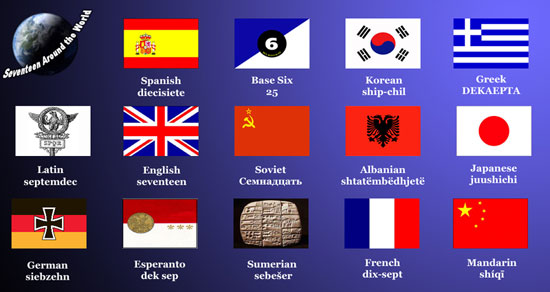
The seventeenth number ever discovered, seventeen is known in France as dix-sept. Like many other prime numbers, seventeen is divisible only by itself and one, though in base-six math seventeen is represented by “25,” which, in base-ten, is not a prime number.

The originators of mathematics, the Sumerians, were the first to develop seventeen, which they called sebešer and represented in cuneiform as a symbol. It would take over three millennia before it would transform into the Roman “XVII.” After the development of Islamic culture, XVII was replaced by the standard Arabic numeral 17.

Throughout history, kings, popes, emperors and the heads of major corporations have used the number seventeen. Even celebrities such as Madonna, Howard Hughes and Bruce Vilanche have, in the course of counting, utilized the number seventeen. Important works such as The Bible feature many chapters known by the numerical designation “Seventeen.” The foundation of American government, a document called The Constitution, even features a section called “The Seventeenth Amendment.” It is the seventeenth of the many amendments to this important and historic document.

Of course, seventeen is not just a stuffy number consigned to old, musty documents. Indeed seventeen is still a vital and important number that continues to permeate the popular culture of modern society. There is a glossy, quiz and makeup tip filled magazine which carries the name Seventeen on its masthead. Ohio powerpop band Manda and the Marbles released, in 2005, a song titled “Seventeen.” First-ranked NASCAR™ driver Matt Kenseth’s DeWalt logo-covered car bears the number seventeen and basketball star John Havlicek proudly wore a Boston basket ball team shirt on which was embroidered the number seventeen.

Of all the 1,207 numbers that exist today, seventeen is perhaps one of the most underrated and yet one of the most intriguing and important. Like twelve or seventy-eight, seventeen is one of the numbers that people enjoy. Seventeen is cool.

flags and numbers

Historigon: Justinuary 2006

Historigon

During This Month in History…

  • 2001 AD: Arizona state senator Arnold Schumaker (L) sends polaroids of expensive toys to underprivileged children in his district.
  • 1986 AD: A live-action manger scene burns down in Czechoslovakia, killing all participants.
  • 1983 AD: The first successful artificial appendix is inserted into Gary Clarkson.
  • 1969 AD: While exploring the surface of the Moon, astronaut Alan Bean finds a rock that resembles his primary school teacher Mrs. Belcher.
  • 1964 AD: Italy changes government.
  • 1943 AD: Airman Eric Jones paints a picture of a pretty dame on the nose of a B-17 Flying Fortress.
  • 1832 AD: Future president Martin Van Buren, after celebrating his birthday, vomits in a spittoon.
  • 1793AD: Marie Antoinette, in the few seconds of life afforded her head after its separation from the body, wonders if heaven will have delicious cakes.
  • 1653 AD: A group of Spanish settlers decide to play a game of pins using Olmec head statues and some old canoes.
  • 1588 AD: Pedro the Navigator informs his captain that the seas ahead appear stormy. Captain Menendez assures him that God will protect the Armada from storms. Later both their corpses wash up near Brighton.
  • 1402 AD: Kim Il-Sung, after inventing a time machine, arrives and promptly invents water skiing.
  • 1301 AD: Geoffe the Slopper of Stuttgart looks up and sees a comet.
  • 1282 AD: Friar Marcus makes a mistake while illuminating a manuscript, suggesting to future generations that he liked rutabagas very much.
  • 1202 AD: While sacking Constantinople, Martin of Tours finds a vase that he thinks his wife might like.
  • 738 AD: The Nanzhao kingdom sets up a strict code of state-mandated, individually-unique hair styles for its citizens.
  • 605 AD: Chinese Emperor Yang-ti orders the construction of a massive canal to link major rivers with the capital of Luoyang. Later that night he sneezes five times in a row, beating his previous record of three consecutive sneezes.
  • 439 AD: Axum resident Derdana asks if maybe they can’t have a few less stele around as they block out the fine Ethiopian sunshine. An unhappy neighbour later mixes goat dung in with Derdana’s stew.
  • 423 AD: A young Attila, later known as The Hun, gives his brother Bleda one of the first known wedgies after Bleda, in an amazing turn of cultural precocity tries wearing underpants.
  • 135 AD: Bill S. Preston, Esq. and Ted “Theodore” Logan arrive at Simon Bar Kokhba’s hideout near the Dead Sea. They describe the situation as “totally un-station.”
  • 21 AD: Sauren the Parthian uses several captured Roman helmets to impress some girls. That night he sires Artabana.
  • 74 BC: Trandovix the Gaul wanders to present-day Gibraltar in search of a good tankard.
  • 712 BC: Numa Pompilius notices a member of his court has slipped an association of drinkers into his proposal for the creation of guilds in Rome.
  • 905 BC: Otonga and his friend eat a pig.
  • 1003 BC: The Olmecs create giant stone heads in mockery of disgraced citizens for use in playing a Meso-American version of pins.
  • 3281 BC: Adresh of Chaldea trades seventy loaves, two goats and an Abyssinian slave man to Ushot of Uruk for seven ounces of silver and two mares.
  • 6.701 BC: Erath the Scout finds a village where they teach him the secret of pottery.
  • 32.801 BC: After spending seven months in the freezing cold, Uguski and his clan begin to regret following that mammoth herd across what would one day be called the Bering Land Bridge.
  • 91,002 BC: While examining the community’s Large Bone with Notches in It, Ogoff laments that things were better back in the old days.

Letters: Justinuary 2006

Written correspondences from good natured gentlemen who have read our previous installments and wish to comment on some aspects thereof.

Dear A&A,
Your advertisement for the Mohorovicic Discontinuity (Caliguly 2006) would also be great for a t-shirt. Unfortunately the molten rock contained within the Earth is called magma, not lava. This really bugs me.
Sabine
Corpus Christi, TX

Dear Editors,
I take issue with Sticker Page in your Clauduary issue (Sticker Page, Clauduary 2006). At the very top of the page you feature a sticker which says “I Dig Dugout Dug.” Dugout Dug is a thoroughly despicable human being. He is unable to wash or clothe himself and his only claim to fame before your infamous lionizing of him on Sticker Page was being kicked out of the Rocklynde, Montsylvania Lentil Soakers AAA baseball team dugout before every game.
Melvin Merkson
Rocklynde, MV

To the Axes & Alleys editors, in regards to Not Even
Wrong review, Springtober 2006:

Thanks for sending this, although I think you guys should lighten up…You have been smart enough to notice what lots of reviewers didn’t, that the book wasn’t especially written for a popular audience, but that significant parts of it were really written mainly for other physicists and mathematicians, although this is cleverly hidden through the avoidance of equations. My publishers also didn’t much notice this, although they perhaps just have unshakeable faith in the public’s willingness to buy something they won’t be able to understand. Anyway, so far I’ve been extremely pleased and surprised at how much attention the book has gotten and how well it has been selling. It really was intended originally for a university press and much more limited distribution. String theorists put a stop to that, now they’re not very happy with the fact that the book’s point of view is reaching a rather wide audience.
Anyway, best wishes!
Dr. Peter Woit
New York, NY

Dear Axes & Alleys,
I am incensed by the latest rash of bestiality reports in the media. Persons engaging in interspecies rape with pit bulls, pomeranians, schnauzers, basset hounds, doberman pinschers, chihuahuas, bluetick coonhounds, corgis, pekingese, otterhounds, and spitzes is just disgusting. Humans should only rape size-appropriate canines such as Irish wolfhounds, borzois, St. Bernards, Rhodesian ridgebacks, and mongrels more than two feet tall. I am constantly amazed at the true depths of depravity to which society plummets; more so the incomprehension of size differences.
Mike Gamble
Sordid Rakehook, WD

Dear Axes & Alleys,
Your classified ads are not actually classified at all. They are randomly arranged. Please fix this or I will cancel my subscription. Also, when are you gonna publish some more Rango and Lem comics? It’s not like they’re that hard or produce, so c’mon lets see the boy and the alien and lets see some actual classifieds some time.
Jennifer Martasko
Seaford, NY

To the Editors,
How come all the ladies on your covers are famous celebrities like actors, singers or models? Why not put an ordinary girl on your cover? Maybe someone who’s just a college student or check out girl at the supermarket? Ordinary, normal girls are hot. It’d be cool to see one on your cover.
Paul David Hewson
Dublin, Ireland