It’ll last longer.
Reply

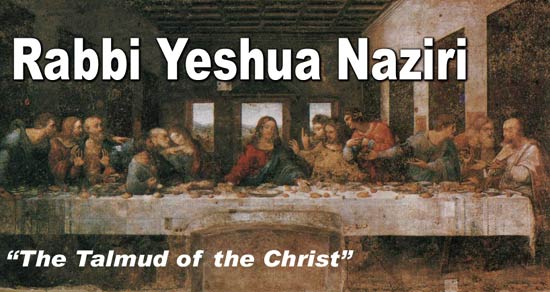
There is a tendency in the Christian world to view Yeshua Nazarite as the first New Age hippie; a long-haired, sandal-wearing likeable guy who strolled about Palestine spreading love and good feelings. While there is a grain of truth to this sentiment, Yeshua Nazarite was more than a friendly guy. Indeed he did spread love amongst the unlovable, peace amongst those foreign to it. However, he was also a scholar, a man learned in the Law and a religious Jew. Yeshua’s teachings did not appear via some process of parthenogenesis, but rather his ideas find their foundation in the Torah interpreted for use by ordinary people in a dangerous world.
The Rabbi as the spiritual leader in the Jewish community slowly evolved in response to the destruction of the Temple and the Diaspora. In the Middle Ages, Jews found themselves without a homeland, caught between Muslims and Christians, spread throughout the known world without a Temple or homeland to link them together. The Levite priesthood disintegrated, and Jewish thinkers such as Maimonides helped to popularize the Rabbinical method as a way to help unify and strengthen the Jewish community in a time of darkness.
Rabbinical thought has antecedents much earlier, but in a time when the priesthood dominated religious practice, the Rabbis were scribes and teachers, though rarely community leaders. While respected members of the community, their role was not truly divine. Unlike the Levites, their place was not set out in the Torah. In the time of the birth of the Roman Empire, Yeshua Nazarite was born into a Jewish community where scholars and priests co-existed, where the Rabbi’s role in the community was still evolving.
It is difficult to pin down the exact date of Yeshua’s birth, though reasonable to assume he lived from around 11 B.C. to 25 A.D. This was a time of great change in the Mediterranean world. A century of civil war had just ended and in the transition the Greek Kingdom in Egypt lost its independence, the Roman Republic was swept away and the world became ruled by the Roman Empire. Its Emperor, Caesar Augustus, became the God of the Known World. To the Romans, Alexander’s once mighty empire was nothing more than a pot of gold to be taxed and pillaged into oblivion. Not even the restored Temple in Jerusalem escaped the greedy Roman vultures.

All those emails we’ve gotten have been answered. As you may have noticed earlier in the week, we’ve added a Merch tab to the site. Now you can get Axes & Alleys stuff manufactured in Chinese and Indonesian sweat shops. Not to worry though, by purchasing Axes & Alleys products you’ll be instructing those third-world denizens in the lessons of capitalism. They’re cheap, they’re sexy, and one of our readers already got laid reading one.
Ask Montezuma What This Shirt Means

Space Penguin!

A&A Logo Tee


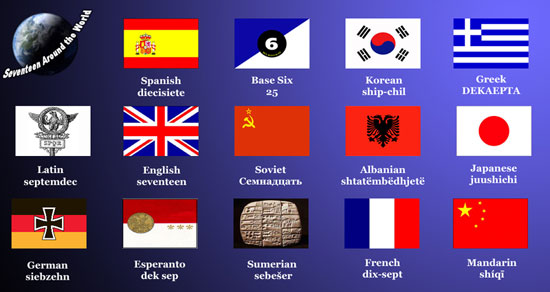
Seventeen is perhaps an easy number to ignore. Stuck forever between eighteen and sixteen, seventeen is often overlooked, even by numerologists. Seventeen may not be as popular as one, eight, a million or three, but the number we call seventeen has a rich history and a deep impact upon our society, perhaps greater even than that of fifty-two.
The seventeenth number ever discovered, seventeen is known in France as dix-sept. Like many other prime numbers, seventeen is divisible only by itself and one, though in base-six math seventeen is represented by “25,” which, in base-ten, is not a prime number.
The originators of mathematics, the Sumerians, were the first to develop seventeen, which they called sebešer and represented in cuneiform as a symbol. It would take over three millennia before it would transform into the Roman “XVII.” After the development of Islamic culture, XVII was replaced by the standard Arabic numeral 17.
Throughout history, kings, popes, emperors and the heads of major corporations have used the number seventeen. Even celebrities such as Madonna, Howard Hughes and Bruce Vilanche have, in the course of counting, utilized the number seventeen. Important works such as The Bible feature many chapters known by the numerical designation “Seventeen.” The foundation of American government, a document called The Constitution, even features a section called “The Seventeenth Amendment.” It is the seventeenth of the many amendments to this important and historic document.
Of course, seventeen is not just a stuffy number consigned to old, musty documents. Indeed seventeen is still a vital and important number that continues to permeate the popular culture of modern society. There is a glossy, quiz and makeup tip filled magazine which carries the name Seventeen on its masthead. Ohio powerpop band Manda and the Marbles released, in 2005, a song titled “Seventeen.” First-ranked NASCAR™ driver Matt Kenseth’s DeWalt logo-covered car bears the number seventeen and basketball star John Havlicek proudly wore a Boston basket ball team shirt on which was embroidered the number seventeen.
Of all the 1,207 numbers that exist today, seventeen is perhaps one of the most underrated and yet one of the most intriguing and important. Like twelve or seventy-eight, seventeen is one of the numbers that people enjoy. Seventeen is cool.