The Dangers of Time Travel

The Dangers of Time Travel

Time travel is not, and may never be, possible. However, a committee at the prestigious Flagstaff Institute of Theoretical Physics has released a new report detailing just how stupidly dangerous travel to the past or future may be. The report is of special concern to our growing corps of chrononauts.

“If you go back in time,” stated Dr. Steven Hawkins at a press conference held in the Luau Room of the Particle Physics Research Institute and Brothel “you may affect causality in numerous ways; say by killing your parents before they screw you into existence, or rolling your ATV over the sherwlike creatures which gave rise to all modern-day mammals.”

However, Dr. Hawkins warns against an even greater threat. “The real danger isn’t from paradoxes. It’s from disease.”

The group warned that the past is rife with all manner of pestilence, disease, and infections including, but not limited to, every disease ever. The FITP committee hypothesizes that a time traveler venturing, for instance, to 25 AD to prevent the Crucifixion would perhaps succumb to amoebic dysentery within two days before he could prevent the salvation of mankind.

“It wouldn’t be a pretty death either,” stated Hawkins. “Even the 19th and early 20th Centuries aren’t safe. We advise not venturing back more than a couple of decades if time travel is ever invented. Which it won’t be, because it’s not possible.”

According to a high-level official at NACTA, the National American Chronambulatory Travel Administration, the report is of grave concern to the nation’s fourth largest department. Both the Armstrong Administration and NACTA refused to comment for this article.

So, while it may be interesting to see what Napoleon could have done with machine guns and a logistics planning computer, any chrononaut who heads to Austerlitz with a crate Kalashnikovs and a planeload of MREs is going to be too distracted by small pox, diphtheria or cholera to enjoy the battle. Furthermore, photographs of Napoleon with a mustache could be taken, which would demoralize modern-day Corsicans.

The future may be safe, though people in the future will probably imprison and quarantine you before you even have time to look up your great, great grandchildren in some sort of futuristic phone book. You’d actually be quite easy for a group of futuristic, leopard-human hybrids to capture and we imagine they will take many photographs of you with their prosthetic audio-visual communication hands.

“If you have to go back, say to prevent Buddhism or something,” Hawkins concludes “it would be best to wear a containment suit that you burn as soon as you return to the present. Of course, you won’t ever do that, because time travel isn’t possible.”

News of the World: The Ants’ Spaceship

ant spaceship

If ants built space ships most people assume they wouldn’t be very big because ants are quite small. Formic spaceships wouldn’t be as tiny as many assume, though, because ant colonies can get to be pretty large, covering acres of land to depths of several feet. Still, a spaceship built by a colony of ants wouldn’t be terribly huge.

The traditional image of ants created through science media is usually one of strife involving raids, slavery, and death. What if the space race brought the colonies together? I like to imagine that a space program would bring the entire race of ants together in a type of social insect utopia. In that case they would need a bigger ship.

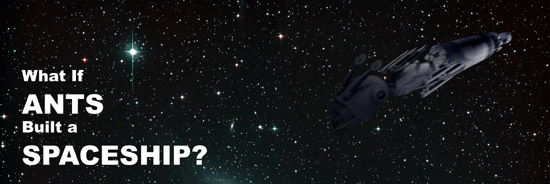
A natural design for such a ship would be the shape of an ant itself, stylized of course to avoid infringing on the sensibilities of any species. From antennae to the end of the abdomen it would measure perhaps 12.7 kilometers long. The widest diameter of the ship would be across the abdomen, at around 6.1 kilometers.

The internal superstructure of the abdomen, legs, thorax, and head are to consist of enclosures which can be adjusted to the direction of thrust, providing a simulation of gravity. When the ship is in free-fall, the carpeted hallways will provide gripping points for the ants.

Propulsion comes through a hydrogen-fueled Bussard ramjet. The long, protruding antennae of the ship and the mandibles located at the front of the head are to produce the field for the craft’s ramjet. Interstellar hydrogen is to be guided through the mandibles and into the mouth, through the central fusion mass conduit modeled on an ant’s gut, and finally into the six fusion propulsion systems located at the tip of each of the leg structures. The fusion system will then provide thrust and power for the ship.

Biomass for the ants’ consumption would be located throughout the abdomen. Special fungus and aphid farms will be installed towards the front of this section for those species who require them. Otherwise the storage facilities will contain vegetable matter.

The thorax of the ship would contain gigantic environmental systems to handle the air and water needs of the ant colonies. The air processors will use oxygen and nitrogen generated by the biomass in the abdomen to supply the vast majority of atmosphere for the rest of the ship, while secondary storage and generation equipment remains on permanent stand-by in case of emergency. Since ants get most of their water from food, the water reclamation system required is much simpler as it is mostly there for the benefit of the biomass.

The filtration and recycling system is to be connected to the biomass storage facility through an open circulation system, constantly cycling water from the abdomen to the processing equipment and back. Connected to the fusion power plant at the rear of the abdomen through a set of tracheae, electrical distribution can be efficiently routed throughout the ship without sacrificing living or storage space. It can then be used as a secondary source for heating due to its proximity to the heating system.

The heating system will rely both on electricity coming from the fusion plant and the warmth from the moist, hot air created by the decomposition of vegetable matter in the fungus farms. After reaching the distribution junction, this air is then passed through the environmental system to extract its moisture, whence it passes to all points beyond.

Living space for the individual colonies will be located in the remaining areas of the abdomen. The fore section of the abdomen will feature environments dedicated mainly to those species residing in tropical and desert biomes, as these decks are closest to the heat distribution system. The top-most section will contain species from dry temperate locations, while the aft decks will contain species from wet temperate locations and those from cold or sub-arctic regions. Colonies residing near the engineering centers of the thorax will be those from environmental regions representing an extreme mix of temperatures and moistures.

The ship’s head is, naturally, to be the command and control centre. The lower portion will ensconce the main computer and auxiliary control systems (such as the Bussard field adjustment computer and environmental control). The upper portion, complete with multi-faceted view screens and other sensors built into the eyes, is the Bridge, which will be staffed by specially grown controller and navigator drones.

Astrogation and propulsion would be controlled directly from the Bridge. At the same time, command officer drones can issue orders to their various colonies through pheromone disseminating pneumatic tubes specific to each species. The pneumatic system carries a control pheromone to the appropriate colony located in the abdomen. From there a pheromone disbursement officer carries the message throughout the colony.

Colony Queens would spend the majority of their time at the Queen’s Deck, located in the bottom aft section of the abdomen, directly above the main docking bay. Most eggs will be kept in the temperature controlled storage decks, while some will be carried directly to the docking bay for placement on the landing pods used for colonizing suitable planets. The single airlock located in the extreme aft section allows for launching colonization pods, as well as for the jettisoning of trash and waste.

As you can see, a multi-species advanced interstellar craft for ants is a feasible idea for the most part. There are some problems surrounding ant cognition, manufacturing methods, and economic systems, but these can be overcome in time. Remember that Mankind took only six decades to advance from flight to space travel, and that ants have already been flying for millions of years.

After coming along with me on this beautiful journey into the possible, don’t you also think it would be wonderful for ants to reach for the stars, come together in filial admiration, and build a fancy, ant-shaped spaceship? I thought you would.

Saturn

Saturn

The Hague, EU – Delegates all agreed that Jupiter sure is large, Earth is chock-full of living organisms, and Venus is bright, but once again Saturn, the ringed wonder between Jupiter and Uranus, took home top honors in the sixth annual “World’s Greatest Planet” competition. Top runners up included crowd-favorite Mercury and dark-horse Twopiter, but neither were able to beat out Saturn’s 308 total votes. OGLE235-MOA53 and HD 114762 did not receive any votes whatsoever, though WASP 2 did win an honorable mention for “Most Interesting Name, Extrasolar Category.”

Convention delegates are chosen from the astronomy community, the astrology community and through a lottery sponsored by Go Icecream! Magazine. Each delegate receives three votes which are color coordinated (blue, yellow, pink) and may be cast in any one of the ten categories. The initial categories are chosen by the host committee and include Best Color, Best Moons, Most Interesting Chemical Composition, and Smelliest Atmosphere.

Each of the 430 delegates casts their color votes (for a total of 1290 votes). The three categories with the most yellow cards are then chosen for the second round.

Delegates are divided into teams of ten members each, and each team chooses a candidate for each of the three second round categories. After lunch and coffee, the teams break up and the second round of voting begins when the host committee members distribute a one euro coin to each delegate.

The delegates place their coins in copper pots representing each of the ten candidates in each of the three categories. Only one vote may be cast in any category of the delegate’s choosing. Once the coins are placed, the pots are weighed by the tallest member of the host committee.

If there is a tie the process is repeated again, though in this optional third round each team chooses a mouse from a clear plastic hopper. The mice then run through any of the pre-chosen mazes provided by the host committee. The first three mice to make it through the mazes determine the final, tie-breaking voting teams, who reorganize according to the proportions of specialists and laymen at the competition and vote using black and white beans placed in a simple leather sack.

Fortunately, no tie happened this year.

In the competition’s only upset, Gravitational Microlensing beat out the Transit Method for “Best Detection Method.” Media reports of Transit Method spokes-model Dr. Ira Shore’s poor sportsmanship and bad manners during the announcement were not exaggerated, as the dethroned detection king ripped off his sash and stalked out of the Paard van Troje Concert Hall, knocking over the open bar in the lobby.

The other results this year were astounding as well. For the fifth time in a row Saturn took home the famed silver goblet for “World’s Best Planet,” while Earth and Mars tied for “Best Volcano,” and Neptune took home the title of “Best Gas Giant.”

News of the World: Pentember 2007

greenland moves

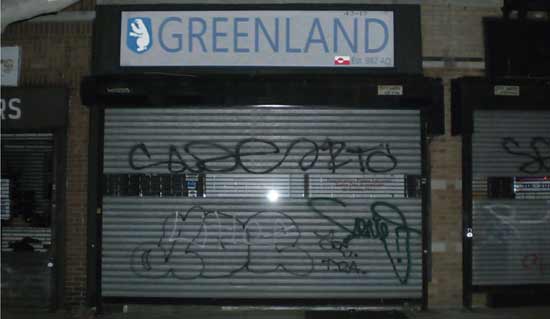
Lobby, Greenland- Because of mounting financial troubles Greenland, the world’s largest island, has been relocated to a storefront in downtown Richland, Elizabethia. After years of mounting debt leading to its impending bankruptcy, the Greenland Executive Management Service this week announced the implementation of a retrenching strategy.

Haarf Goodmansdottir, acting representative for GEMS, stated in a press release: “Most people don’t realize how expensive it is to operate the world’s seventh largest landmass 24 hours a day, six days a week. In order to continue doing business we shall be moving all operations to a new, inexpensive location. We apologize for the disruption in service, but we’re moving effective immediately. Any further whaling or wife swapping needs are being handled through transitional offices in Iceland.”

Greenland’s old location measured 2,166,086 square kilometers, much of it ice covered. The new Greenland will take up only 2500 square feet of commercial space, including a back storage room, a lobby and a fully-functional half-bath. A few of Greenland’s larger towns, including Nanortalik, Paamuit, Sisimuit and Qaanaaq Thule have been transferred to a four-tiered aluminum shelf for safekeeping until the landmass can solve its financial problems.

Mount Gunnbjorn, at 3700 meters the island’s highest point, has been replaced with a new highest point: an eleven foot tiled ceiling. Unfortunately, a few of Greenland’s fifty thousand people have been laid-off as the bunks in the storage room can only accommodate four, or eight if they don’t mind sharing.

greenland moves 1
Yes, There is a Drinking Fountain: The new Greenland will be open for business sometime in the early days of the Second Quarter of 2007. Be sure to check out the videos. They even have a copy of Deep Space 9, Season 2.


Greenland’s new cashier (and former Prime Minister) Hans Enoksen, told reporters “After all the trouble we’ve had financially and with Denmark and the EU, it’ll be nice to have a new set of neighbors. We are looking forward to a cordial relationship with the Day ‘n’ Nite Deli and the Happy Smiles Nail Salon.”

The ice-covered landmass in the Atlantic is currently vacant, although both Sinonipponesia and Disney have reportedly made offers. Like many other islands, the former site of Greenland is surrounded on all sides by water, which analysts believe makes it especially attractive to Disney.

“This is a difficult time, but one filled with the opportunity to sell used furniture and appliances,” stated one member of the Landstinget. “While we have lost the world’s largest island, we have gained a Parcheesi set which the old tenants left behind. I look forward to a few games in the coming weeks, especially because those dice cups are so much fun.”
If the new used goods operation is successful, Greenland plans to implement a rent-to-own DVD business and pay for one employee to take classes towards a bachelors degree in notary public.

Greenland will no longer be just another place, but an all-inclusive destination offering the chance to purchase a slightly-worn recliner, have signed documents made official, and get on the path to home video ownership.

The March of Progress: Justinuary 2006

Mammals and Muffins

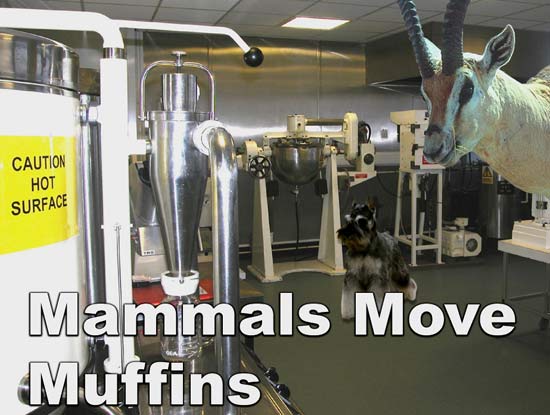
Monrovia, MV – Researchers at Magic Muffin’s Research Campus have been working diligently in the service of muffin sortation. For the past year, Dr. Edward Jacobs and his team spent the majority of their time working to train various creatures in muffin separation in an effort to make the manufacturing and shipping processes more efficient. Surprisingly, they have found very little success with snakes.

“Snakes have been used for some time in microchip manufacturing,” says Jacobs, “but their sortational aptitude there does not seem to translate to muffins or virtually any other consumer package good.”

During the course of our interview with Dr. Jacobs, we passed through the test subject living quarters where we saw many dogs, old world monkeys, several ungulates and, surprisingly, a sloth.

“The sloth is actually fairly good with blueberry and poppy seed,” said Dr. Kelly Jacobs, Edward Jacobs’ daughter and assistant. She later told us that the sloth was “just a bit slow,” but she did not want to hurt his feelings by saying so in front of him.

Dr. Jacobs’ (the elder) prize animal is a schnauzer named Murray, who has received high grades in all the major muffin sorting axes including chocolate, chocolate chip, double-fudge chocolate, and bran. Dr. Jacobs (the younger) also sees promise in Hoody, a four year old Thompson’s gazelle who has proven quite skillful in some preliminary cupcake tests.

“Dad gave me some research time on my own and I wanted to see if maybe Hoody didn’t have some abilities outside of the corn muffin-oat muffin continuum,” explains Jacobs.

She points out that the major differences between cupcakes and muffins are frosting and size. Larger cupcakes are often mistaken for muffins, so the research team often includes a few in the muffin testing.

Javier McClintock, Vice President of Human and Animal Resources, says that once the results of the testing are reported in February, Magic Muffin will make a determination about which animals to put on the factory floor. Should the report be favorable, a test program will begin in their extra-national production facility located in international waters to avoid legal entanglements and taxation.

“After that,” says McClintock, “we plan to roll out schnauzer and gazelle sortation teams in
all of our muffin production facilities by quarter 3 of 2007.”