The March of Progress: Fabuly 2007

Release of the Picturenary!

picturnary

Every library contains a dictionary, as do many homes and bookshops. And why not? It’s a useful thing, a dictionary, for it lists and defines every last word in the English language. Should you want to know what a word means, how to pronounce it, its category or origin, you need only consult a dictionary. But what about pictures?

Finding information on pictures has always been a difficult task, made perhaps more difficult by the lack of suitable reference materials. This week that all changed as the Movable Type Printing Company announced the publication of the first eight volumes of the long-awaited Picturenary.

Once completed, the multi-volume work will show, with accompanying information and learned commentary, every picture in existence; including photographs, drawings, mosaics, etchings and napkin doodles.

While sought after by several large reference collections, pre-release sales of the Picturenary have been far below expectations. In response to the slow sales, Movable Type Printing announced that they would speed up production; releasing three volumes per year, instead of the two planned.

The currently available eight volumes contain some 43,000 pictures, all of them of aardvarks, the city of Aachen or men named Aaron. By 2012, the Picturenary should move forward into pictures of abacuses and Abbasids. . Photographs of the letter A will be saved for a special series of volumes featuring pictures of words and a series of special volumes have been set aside for abstract art which will include multitudinous interpretations of the work.

Picturenary editor Horvald Tomlinsson was taken aback when asked about the recursive problem of the Picturenary. That is, that for each image shown, a new copy of the image is created requiring another entry in the Picturenary. Tomlinsson responded that perhaps a blue-ribbon panel could study the subject, or the internet could help.

As part of the announcement, Movable Type Printing has requested that all people in the world send in copies of their snap-shots and vacation pictures, especially if they are named Abbey or have recently visited an abbey.


The Sordid History of the Picturenary!

Since the first Cro-Magnon men and women wrecked the cave walls at Lascaux with their graffiti of bison, mankind has dreamed of having a Picturenary. The first attempt to catalogue all known pictures was undertaken in 215 B.C. when Chinese Emperor Chin ordered his artisans to create ceramic miniatures of all known statuary. Unfortunately, Emperor Chin died before the project was completed and it was abandoned during the Great Han Pottery Destruction.

Thousands of miles away and hundreds of years later, the Council of Nicea planned to create a collection of all known pictures of Christ and the Disciples, to act as a companion book to the standardized Bible. This effort was abandoned when the Council of Hippo declared The Pictoriam to be a route to the sinful worship of graven images.

In the early 19th Century, Frenchman Joseph Nicéphore Niépce became the first person ever to successfully compile all known photographs when he placed the first photograph on his desk.

The Picturenary’s only modern antecedent was a DARPA project begun in 1972. The effort relied on creating a miniature black hole in the belief that an object of infinite mass would contain infinite information. Unfortunately the project was found to be missing at least 433 entries after a project scientist looked up a pair of drawings his son had made as a child and found them absent.

It wasn’t until 1998 that an ambitious young editor at Movable Type Printing, a Daniel Bester Inc. company, first began the modern Picturenary, when his collection of pornographic images won the Nobel Prize for Photography Accumulation. And the rest, is history, or more accurately, the rest is current events.


March of Progress: Gregor 2007

Metal Rings Now Obsolete
In what is being hailed as a revolutionary breakthrough, technicians at Toledo’s Bester Labs were able to successfully attach plates to a metal ring. Also made of metal, the plates have now rendered plate-less metal rings completely obsolete. This is a major step forward in metal ring technology, an advance unequalled since metal rings were first developed in the early 1930s.

For decades, many in the metal ring industry had considered the addition of plates to be science fiction hokum, a belief which was dispelled in 1998 when metal ring technician Amanda Brock published a mathematical proof that plates would be possible, under certain, difficult to achieve conditions. Though many continued to debate the veracity of Brock’s claims, a few advanced labs began testing to determine if plates could be successfully added to metal rings.

After nine years, and fifteen billion dollars, Bester Labs managed to fulfill the dream of countless generations by adding plates to metal rings for the first time. “This signals the dawn of a new age,” said Assistant Ring Technician Tommy Branson. “With pluck, determination, and a few billion dollars, anything is possible, even plates on metal rings.”

The prototype metal ring with plates, dubbed EVX-17, will be on display at the Toledo Hall of Science until January.

News of the World: Gregor 2007

development

Evanston, EL– In a form letter sent to residents and business owners, the City Council formally announced its plan to hold a meeting to address citizens’ concerns over the proposed re-zoning plan for the area of North Street between West Main and Route 202. While the area in question has remained rural and undeveloped for decades, two large tracts of land have been sold to developers who hope to build a new housing sub-division and to the BestMart company who has plans to build a new BestMart Super Center near the intersection of North and Route 202. Currently, the area is zoned Light Commercial and Residential, but some community groups have protested, citing geological surveys suggesting that new developments could create runoff, possibly flooding Uchee and Neary Creeks during downpours.

Residents of the nearby Pine Woods and River Run sub-divisions have formed a lobby group, though they have yet to make any official statement about the City Council’s proposed meeting. Resident Maria O’Malley issued a statement on her blog, in which she stated ten major issues she had with the new rezoning plan, including increased automobile traffic and increased taxes to pay for new road maintenance. Other residents have stated that if the area is rezoned as Medium Commercial, it may affect their property values.

Prince County City Planner Raymond Jones, a twelve year veteran of Evanston civil service, had this to say “Evanston is growing and development can have both downsides and benefits. Of course we’re going to listen to all sides on this issue and make a decision that will work for residents as well as for commercial interests. I look forward to a productive meeting.” According to inside sources, speakers at the meeting may include Deputy Planner Elaine Meyers, Council Chairperson Willard Thomas, Residents Association President Marlene Kaplan-Hughes, and perhaps even Chamber of Commerce President Michael Mattingly, Jr. Plans for the meeting include the reading of the minutes, a pledge of allegiance to the flag, as well as a question-and-answer time which will allow private citizens to voice specific concerns or opinions.

Whichever course the Planning Office and the Council choose, all agree that this is an excellent example of community involvement in civic affairs and that perhaps such an amicable relationship will enable Evanston, and all of Prince County, Elizabethia, to grow and prosper in the coming years.

rectangle

The March of Progress: Aphros 2007

corndog

Years of laboratory and statistical analysis have led to consensus in the scientific community on the subject of corndogs. The Corndog Tastiness Theory stood up to every scrutinizing test devisable and has now been declared a law of nature, taking a place alongside motion and thermodynamics to form the triumvirate pinnacle of scientific achievement.

There is still some dispute on the development of corndogs. Why did they only appear in the late Nineteenth Century? Was there some physical mechanism suppressing their creation? Hardnosed researchers, resembling film noir detectives more than scientists, have at last untangled this daunting enigma.

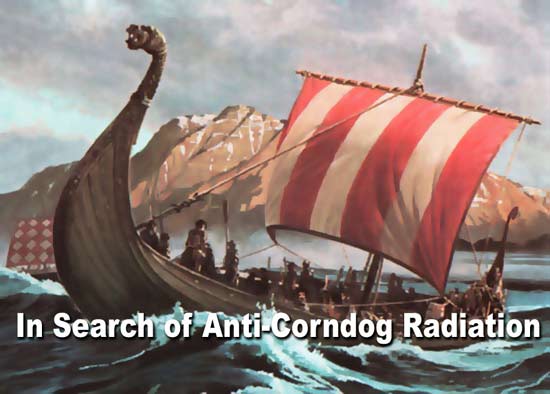
Axes & Alleys spoke with Professor Samantha Blockart, whose latest paper (co-authored with graduate student Sydney Favre) has sent shockwaves through the laboratories, universities and research-o-toriums of the world. It’s hard to imagine that this fedora-wearing, trench coat wrapped scientific maven, unassuming in most regards, could have finally solved this riddle through her Anti-Corndog Development Radiation Hypothesis, which states that a previously unknown form of energy created by the existence of Vikings prevented the creation of the delectable treat.

“It’s impossible to believe that a wonderful, tasty, self-contained comestible such as the corndog would not have been invented earlier in human history,” says Blockart. “Early peoples had meat and corn, and could easily have created the corndog. Yet all the evidence points to the Fletcher brothers introducing the batter-dipped meat sausage on a stick in 1942.” She concluded that “the means to do this existed beforehand, so why were they not created?”

“See, after looking at this proud progenitor of the moist, juicy dogs we enjoy today, it hit me: corndogs weren’t developed until after Scandinavians stopped going viking, creating polities in their homelands and colonies across the sea. Somehow, Viking warriors prevented corndog development. Nowhere in the sagas do we find a king outlawing corndog research, so it follows that the Scandinavians didn’t even know they were standing in the way of corndogs. The only answer is that by plundering monasteries and raping women from the North Sea to the Mediterranean, they were creating an emission of some sort of energy that prevented corndogs. It’s the only possible explanation.”

For five years, Blockart and her graduate research team have investigated every site of Scandinavian incursion and settlement from Norway and Denmark, to Eastern England and even the old midden heaps of Dublin. They spent several seasons cataloguing artefacts and scanning them with advanced equipment such as eyes and hands.

Their findings have been overwhelmingly positive, as not a single fragment found throughout the Scandinavian regions has any detectable trace of Anti-Corndog radiation, proving that in the ten centuries following the cessation of large scale raids by Scandinavians, all the energy had dissipated. So powerful was this energy that it took more than a thousand years to fade, allowing the development of corndogs to begin in the 1920s.

Mr. Favre said that we should all thank Christianity for the corndog “Without the centralizing authority of the Church, as well as the cultural influence and increased military strength of the Northern and Western Europeans, the Scandinavians wouldn’t have discovered how much nicer it was to settle down, do some farming, and enjoy intercourse with willing, monogamous partners.”

After pulling a fresh corndog from the warming carousel Dr. Blockart has running in her office, Mr. Favre concluded “because of that, their Anti-Corndog Development Radiation eventually disappeared, leading to us being able to enjoy wonderful, wonderful corndogs.” At which point, Mr. Favre took a bite of his corndog with gusto.

News of the World: Apros 2007

Walloon Independence Brigade Claims Responsibility
Brussels, Belgium, EU – As onlookers gawked and emotions ran high, officials could do little but shake their heads and wonder why.

“Why?” asked Transit Supervisor Daniel Daumhus. “Why would civilized people do so poor a job painting a bus?”

Though the government attempted to reassure the public, witnesses to the tragedy reported that the undercoating was unevenly thick. The Transit du Brussels logo had several words misspelled, while the newly installed tires made sounds like a bell. Rust protection was absent and there were clearly drip marks which showed that the paint had been globbed on in parts.

Ivak Bingson, acting head of the Walloon Independence Brigade, appeared in a video the
group brazenly made. On the terrorist’s website he made the bold claim taking credit for poor workmanship and all of the blame. Shaking with fury, he promised that the clumsiness would continue unless the government gave amnesty for Walloon parking tickets forgiving every last cent.

The bus attack was the fourth this month in Brussels alone. The first was the upside down hanging of a public telephone. An antique clock was dropped by members of the Walloon bar and the next week two newspapers were left on a subway car. Only days prior to their attack on the bus, the WIB caused a city-wide fuss; unplugging no less than four Lite- Brites® and a soft drink vending machine under cover of night.

“These attacks will continue as long as the Belgian oppression continues to oppress us via its government intercession. Walloons forever!” Ivak boldly declared via an online webboard called Smurfs Ensnared. Moderators countered by requesting politely that future comments not depart from The Smurfs so lightly; episodes, characters, metaphysics,
distribution, art, fan-fic, or the Region 02 DVD of Season One rumoured to be in production.

Meanwhile the people of Brussels can only endure, never knowing when the next Walloon attack will leave them insecure. Commisar of the Police, Vaan Haar der Veer stated that “We [das Polizen] will remain will get our people clear. It is true, they will microwave taco shells in violation of the instructions on the package, causing much devastation. They may
place mediocre paintings in ugly frames, they might mix up the pieces of strangers’ board games, they may go to banks and attempt to cash several cheques made out for mere fractions of a euro cent. They’ll probably place spectacles upon the eyes of statues, they may even go to the Lost & Found and claim items they did not actually lose. But rest assured, we will finally stop the WIB and bring this terror to an end, that you will see.”

“I sure do hope so,” said a small child, clutching a teddy bear.

Info Rectangle